
Photos Courtesy of Karen Caster
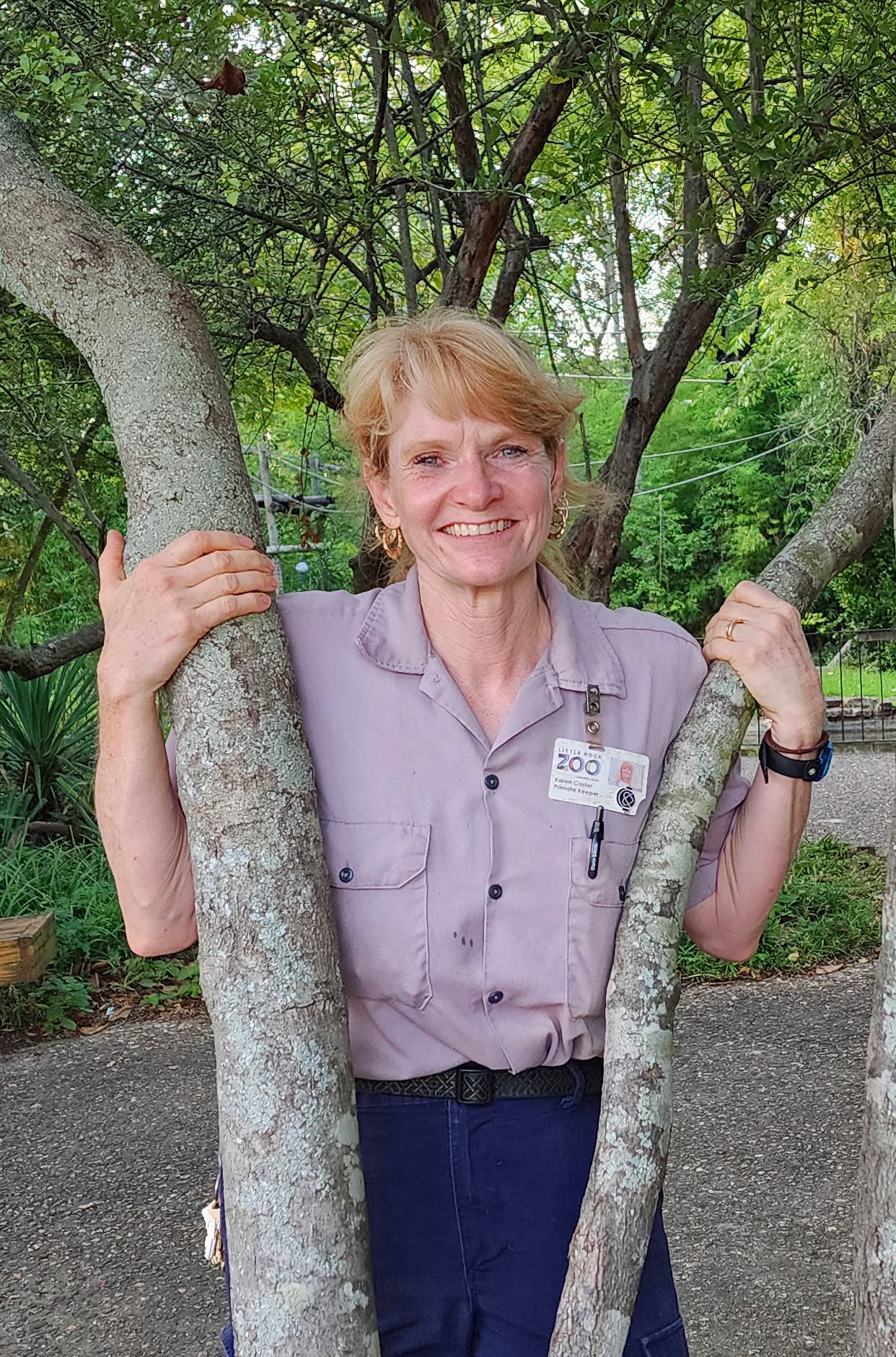
Karen Caster as she celebrates 30 years at the Little Rock Zoo!
LITTLE ROCK (October 29, 2026)— You may not know Karen Caster by name, but if you’ve spent time at the Little Rock Zoo—or followed us online—there’s a good chance you’re already familiar with her work.
For the past 30 years, Karen has dedicated her career to caring for animals at the Little Rock Zoo, working closely with various primate species and building relationships with individual animals that have spanned years, and sometimes decades. But her impact on the Zoo extends well beyond the animals in her care.
Karen is also our unofficial-official Zoo photographer.
With an incredible eye for capturing the personalities, behaviors and special moments of the animals who call the Little Rock Zoo home, Karen has documented countless pieces of our Zoo’s story through her photography. Many of the images she has captured have become familiar sights themselves, appearing across our website, social media, and promotional materials.
In fact, take a look around the Little Rock Zoo website and you’ll find the credit “Karen Caster” alongside photos of many of our animals.


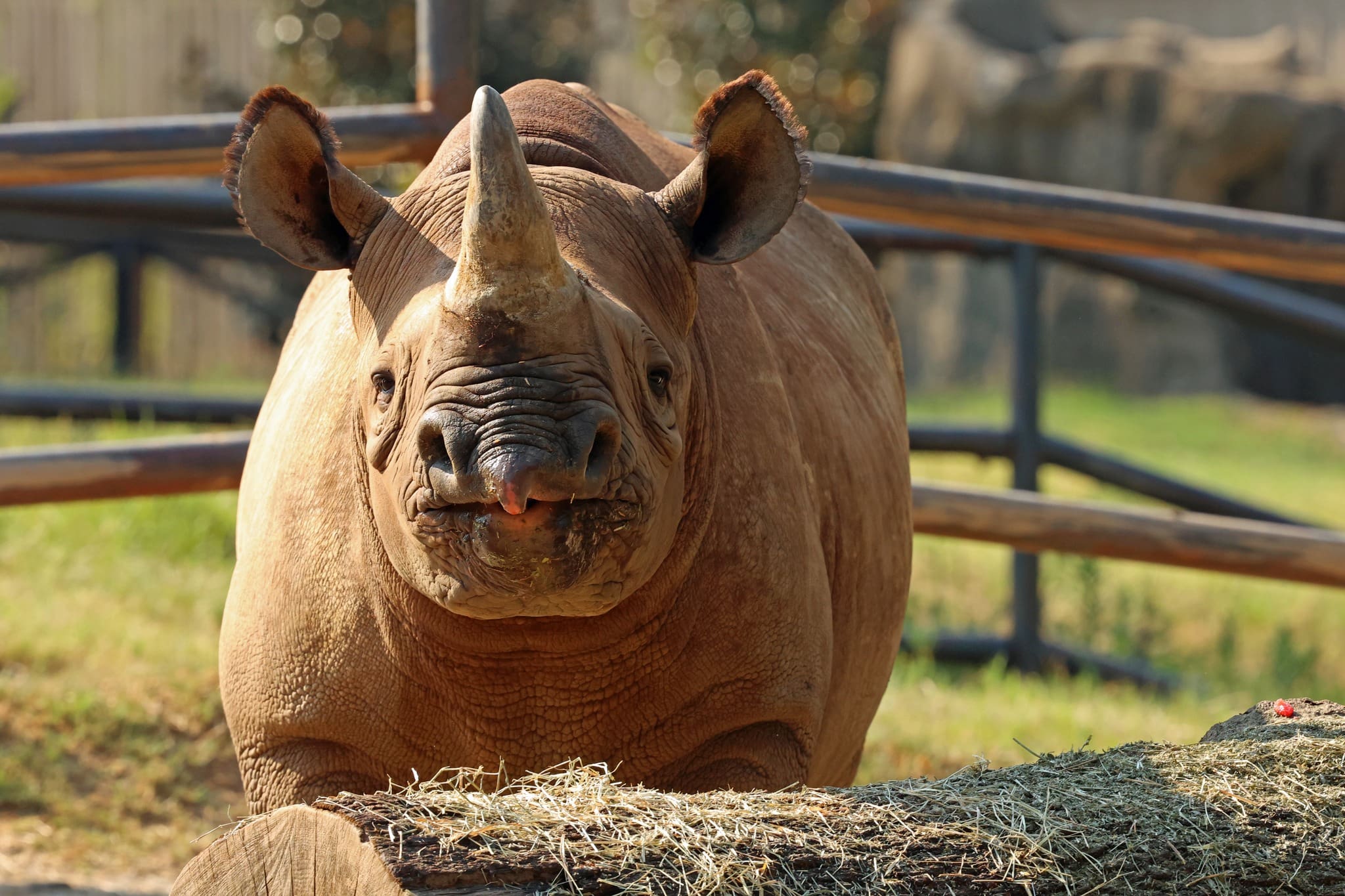
Just a few of the many moments Karen has captured through her lens, featuring Amari the chimpanzee, Iroh the Komodo dragon, and Kevin the rhino.
Her photography has been an invaluable resource to the Zoo’s Marketing team, helping us share stories that words alone can’t always tell. From milestone moments and new arrivals to the everyday expressions and interactions that show just how unique each animal can be, Karen has helped generations of guests see the Zoo through her eyes.
But behind the camera is a zookeeper who has spent three decades doing the work that sets the stage to make those moments possible.
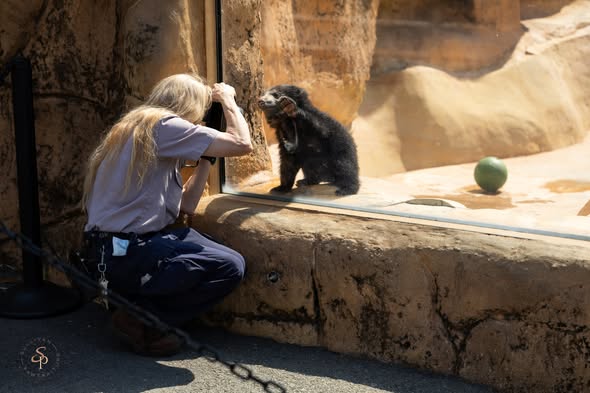
Karen photographs one of the Zoo’s sloth bear cubs. Photo by Jessica Sullivan.
Karen is one of the many dedicated people who have helped shape the Little Rock Zoo into what it is today. As she celebrates 30 years as a zookeeper, we’re celebrating not only an incredible career milestone, but the passion, knowledge and commitment it takes to devote a lifetime to caring for wildlife.
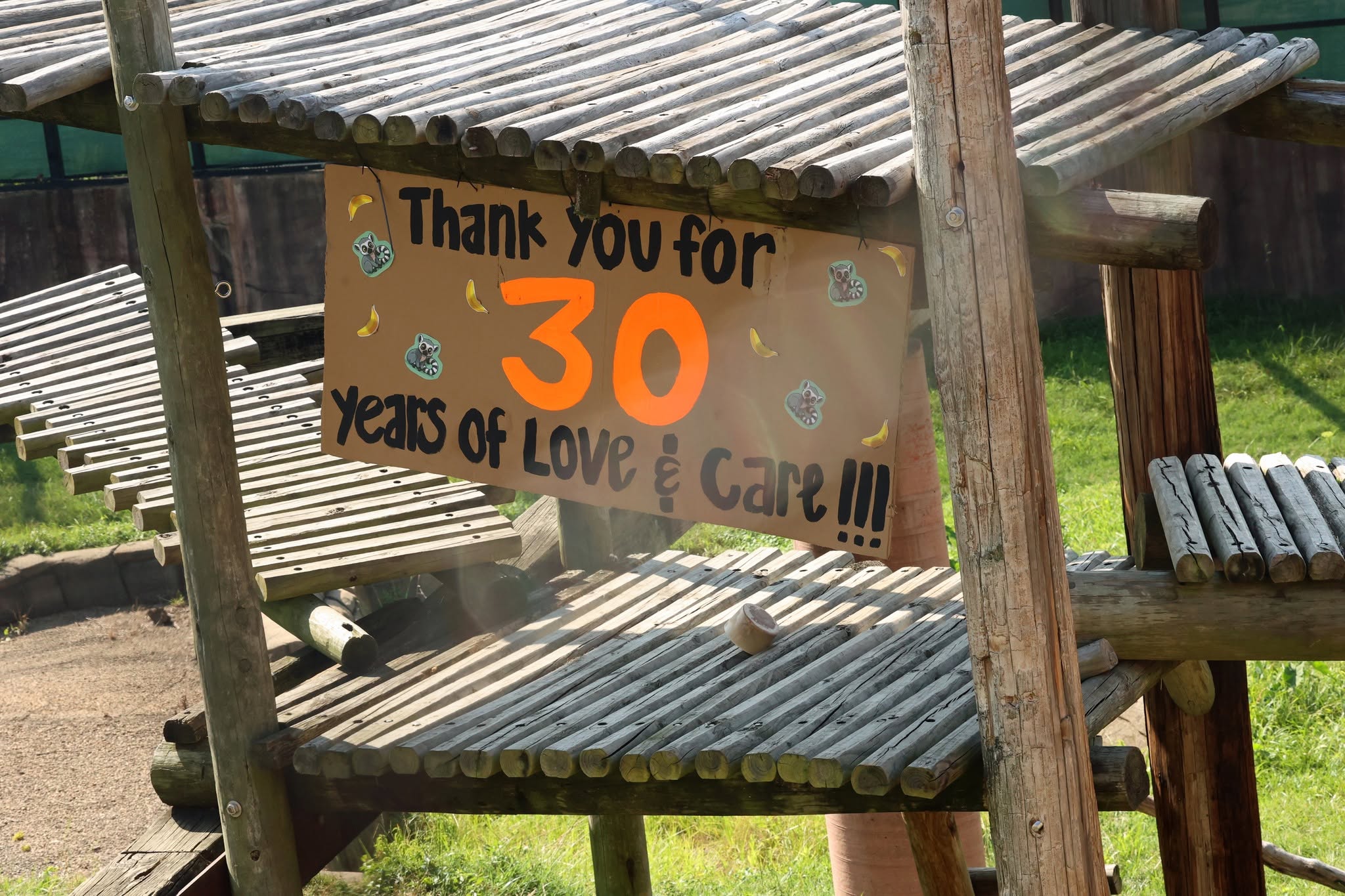
Special gorilla enrichment celebrating Karen’s years of dedication and care.
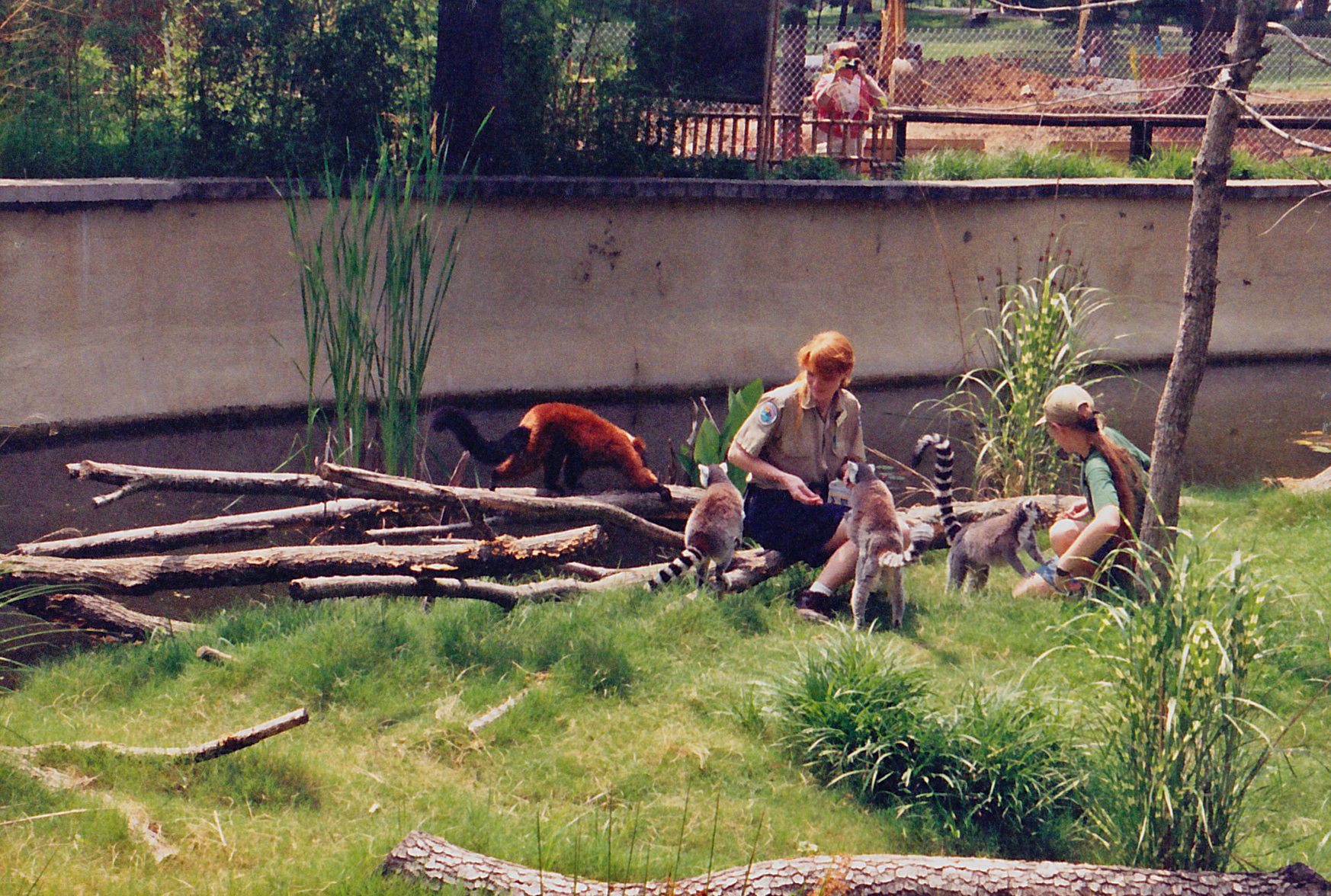
Karen and Melissa with the lemurs on Lemur Island in 1997.
So, what does it take to be a zookeeper for 30 years?
For Karen, it all started with a love of animals—and a realization that the career she had originally imagined wasn’t where she belonged.
Finding Her Way to the Zoo
Believe it or not, zookeeping wasn’t always part of Karen’s plan.
“Zookeeping was not something that had ever entered my mind as a career when I was growing up,” Karen said. “It just wasn’t a job that was prominent, especially for women.”
When she started college, Karen was actually a business major. A summer spent doing temporary clerical work in an office, however, quickly showed her that an office career wasn’t for her.
She began doing some soul-searching.
“I decided I wanted to do something with animals and started researching animal-related careers,” she said.
This was before an internet search could produce hundreds of possibilities in seconds. Instead, Karen found and purchased a book about careers working with animals and began exploring her options.
Veterinary medicine crossed her mind, but zookeeping stood out.
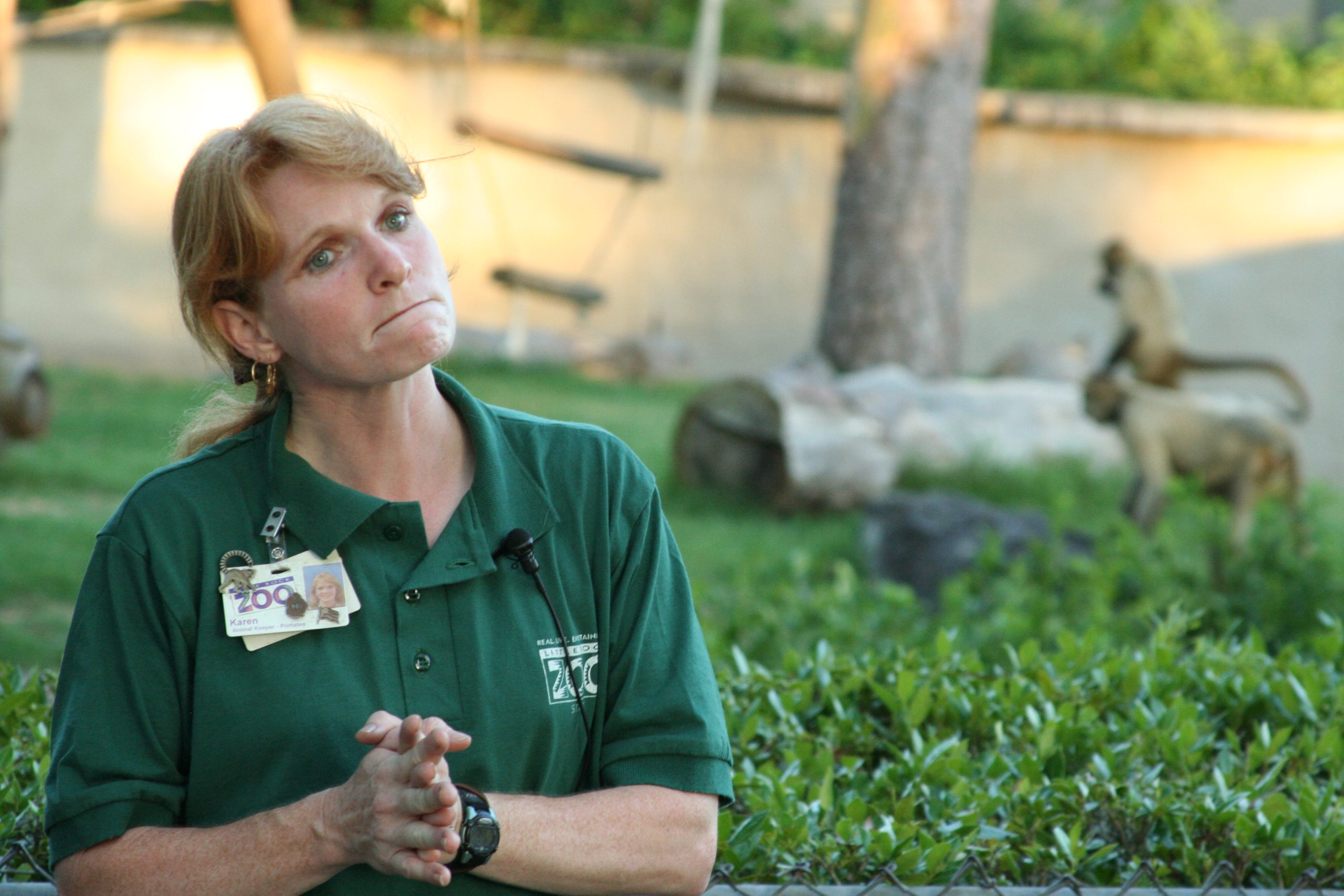
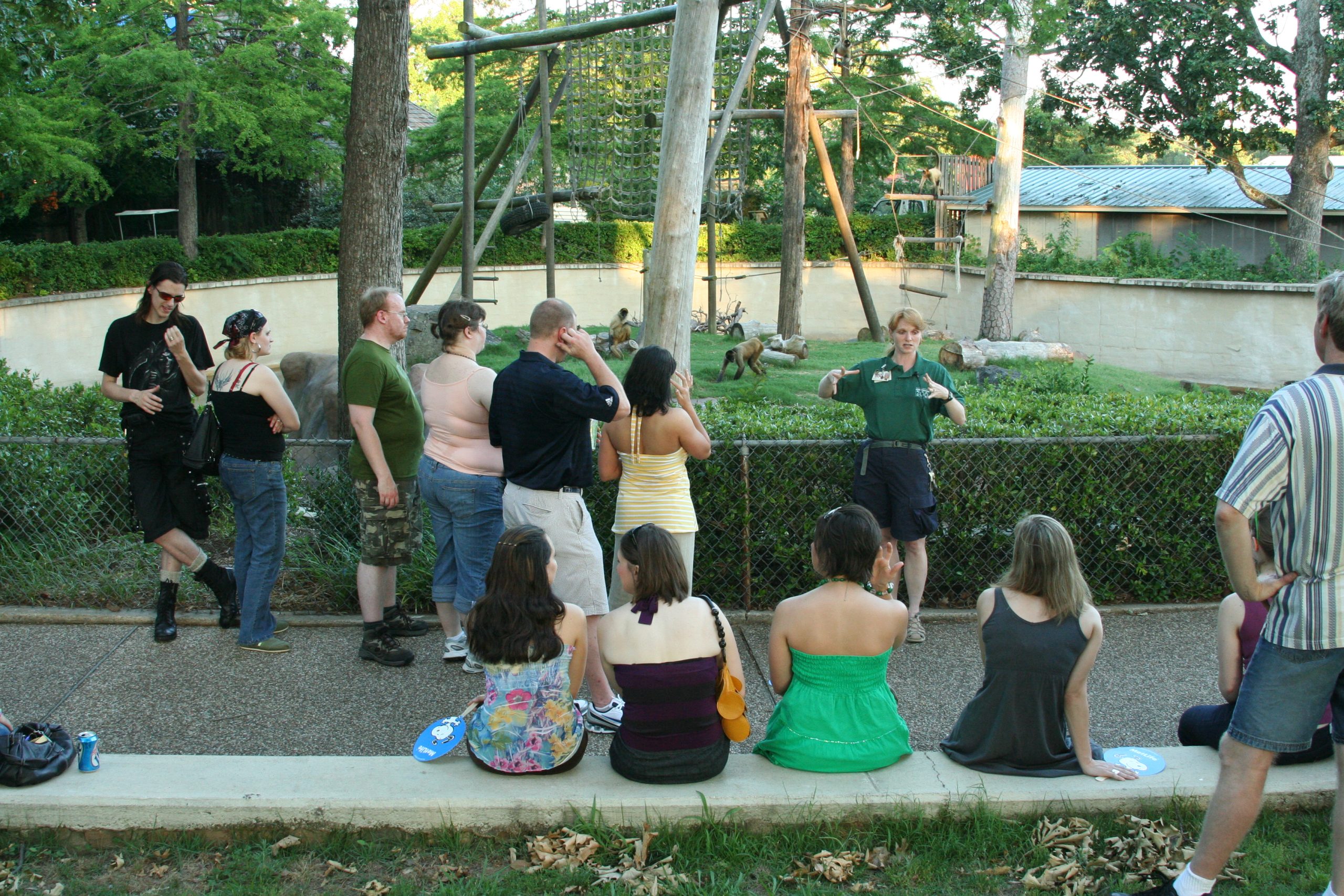
Karen sharing her knowledge of spider monkeys during a keeper chat in 2008.
With no previous science background, Karen enrolled in a few biology courses to see how she would do. She did well and eventually became a docent at the Little Rock Zoo. At the time, volunteers had opportunities to work alongside keepers, giving Karen valuable firsthand experience with the profession she was beginning to envision for herself.
The Zoo was close to home and school, making it a natural place to start. Two years after graduating, Karen was hired as a zookeeper.
Thirty years later, she’s still here.
“I was hoping I would retire as a zookeeper,” she said. “It looks like it will become reality.”
And in those three decades, Karen has seen animals grow from birth through old age, watched the science of animal care evolve, contributed to work beyond Little Rock, helped shape programs at the Zoo and collected more stories than could ever fit into a single blog post.
Through it all, one thing has remained constant: the animals.
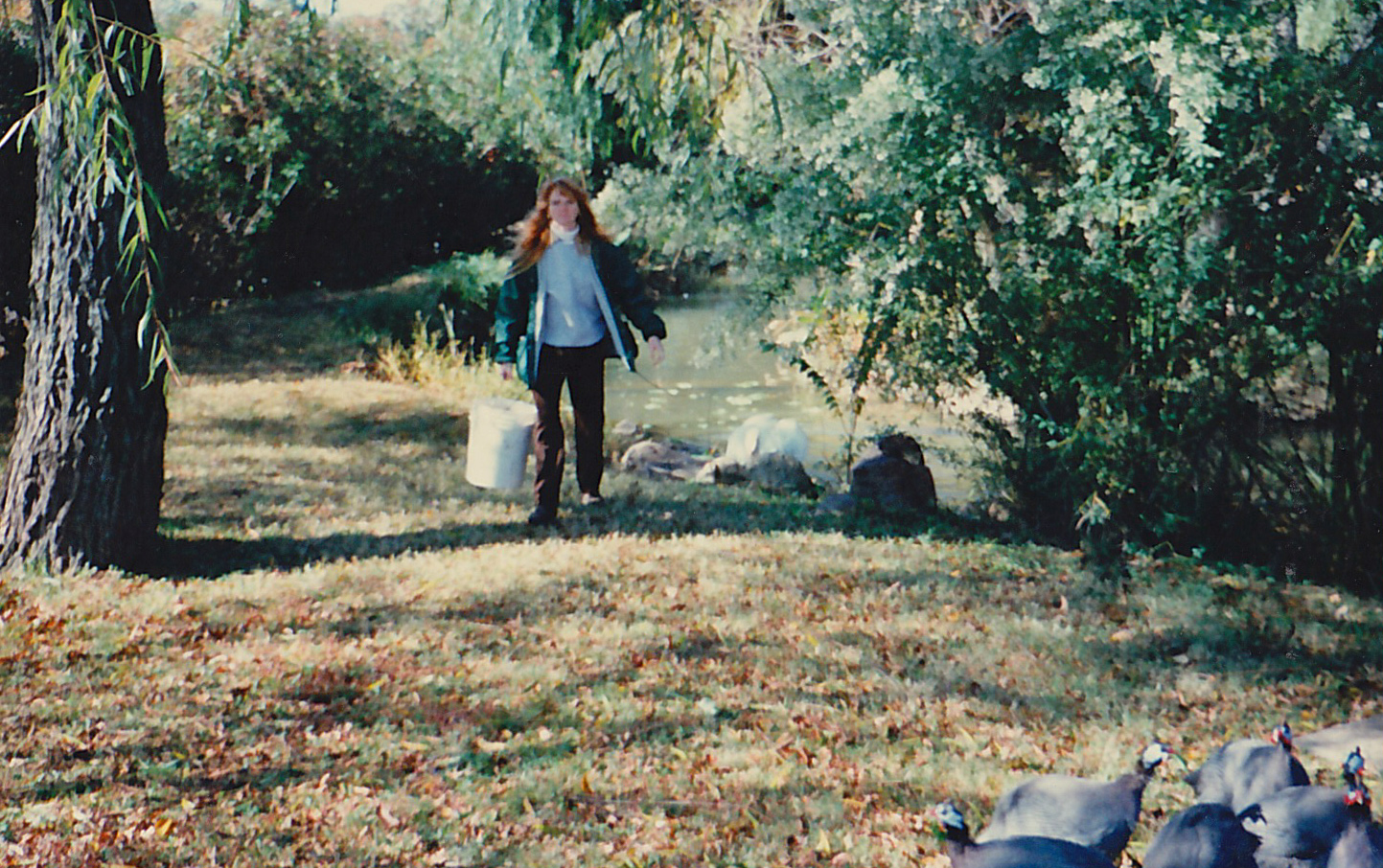
Karen working in the Zoo’s Bird and Nursery areas during her early years at the Zoo in 1996.
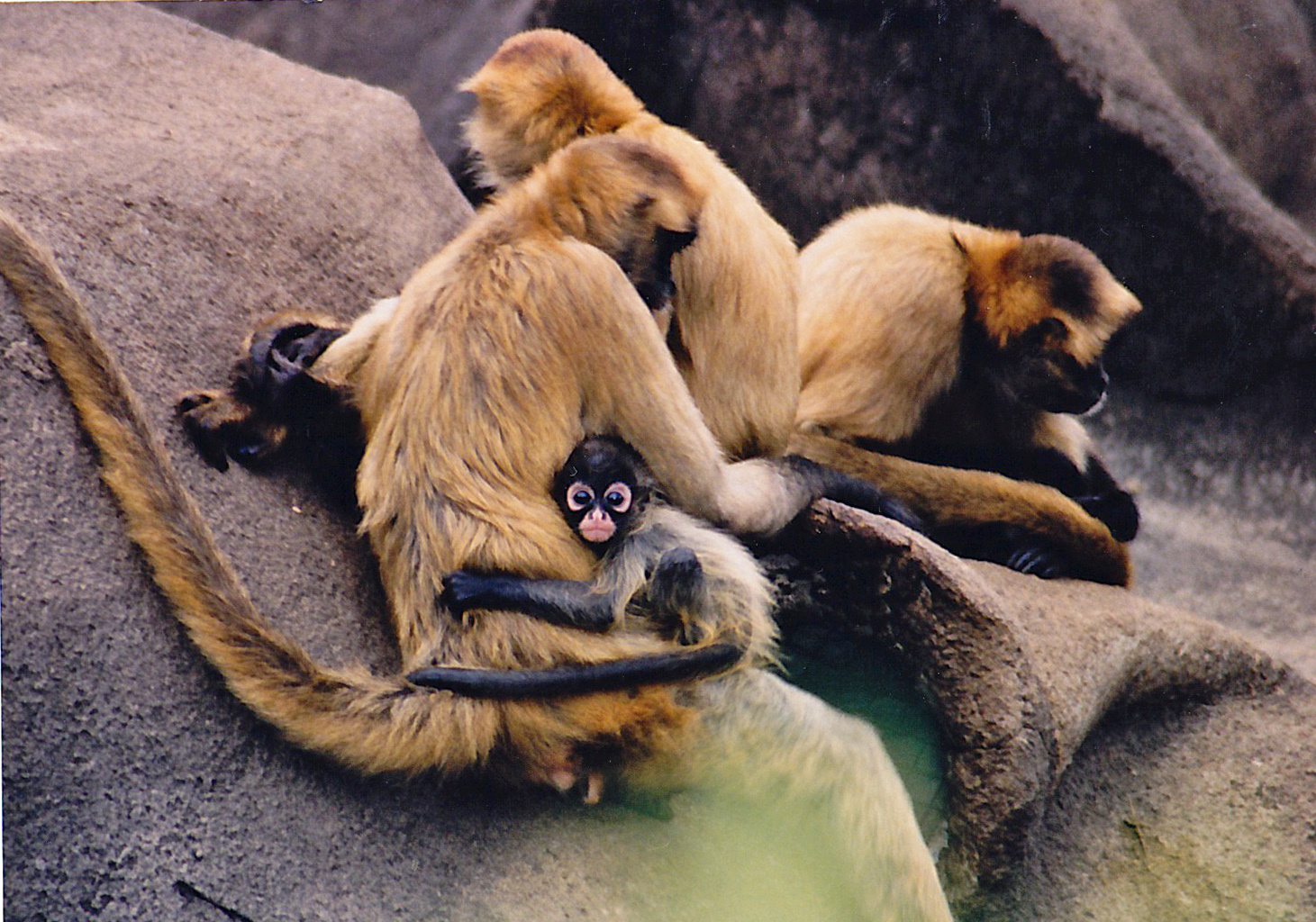
Black-handed spider monkeys in 1998—a species Karen continues to care for today.
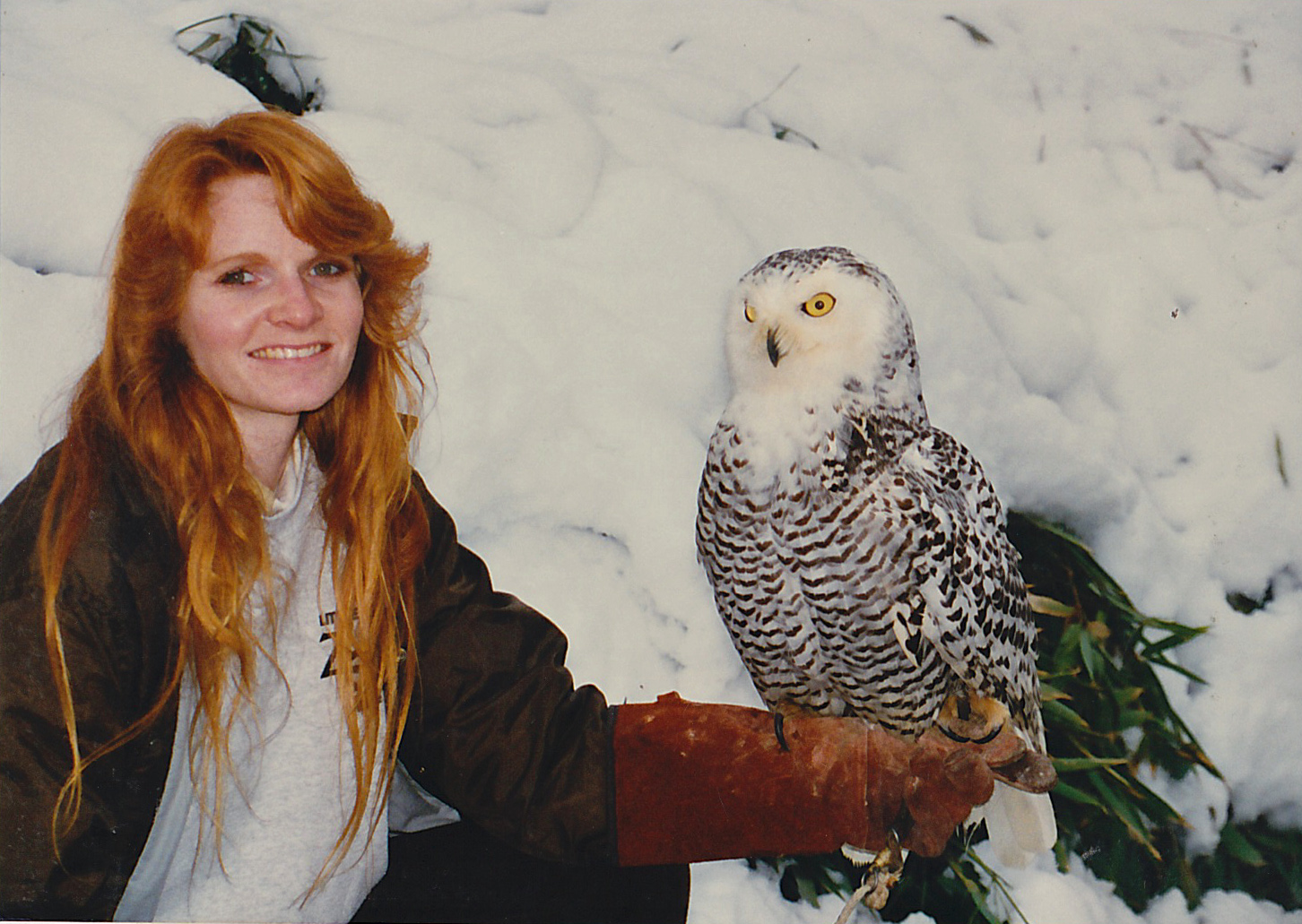
Karen holding Aurora, a snowy owl, in 1997.
What Does It Take to Stay a Zookeeper for 30 Years?
Ask Karen what has kept her passionate about the profession for three decades, and her answer is simple: the animals.
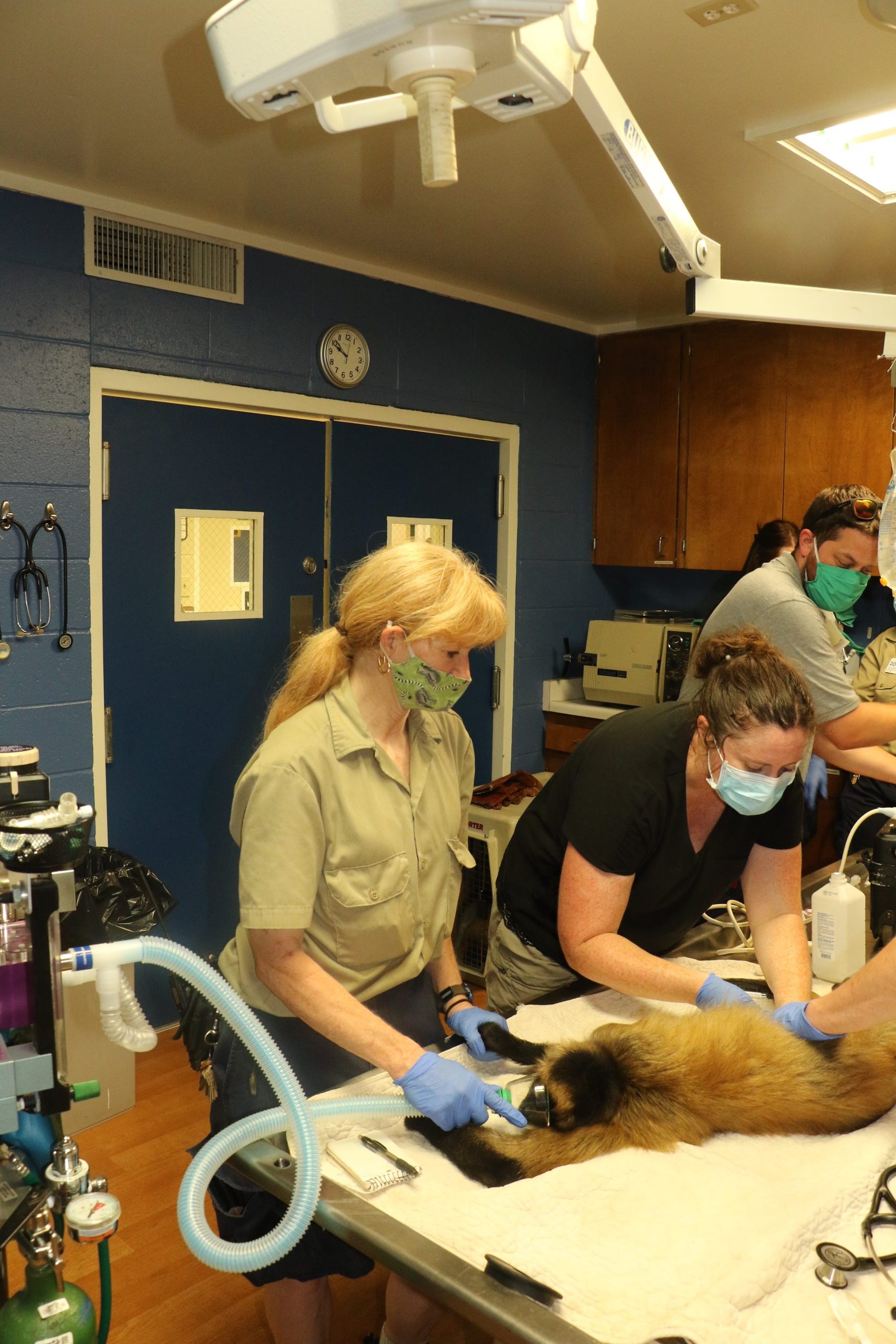
Karen assisting with a spider monkey veterinary exam in 2022.
“Everything for me is about the animals,” she said. “Just being any part of their lives is enough.”
Over 30 years, Karen has cared for some animals through nearly every stage of life, building relationships that can take years to develop. Those relationships are also part of what makes the profession emotionally demanding. Caring for living things inevitably means experiencing loss.
“It’s a job of the heart,” Karen said.
That means successful keepers need much more than a love of animals.
Karen points to patience, strong observational and problem-solving skills, flexibility, empathy, an open mind and the ability to work both independently and as part of a team. Keepers also have to be prepared for plans to change quickly.
And perhaps most importantly, she says, they have to leave their egos behind.
Animal care is collaborative work. Keepers, veterinarians, managers and other animal care professionals may have different experiences and ideas, but everyone is working toward the same goal: providing the best possible care.
“Always assume good intent,” Karen said. “We are working with other passionate people. We all just want what is best for the animals.”
Continuing education is also an important part of that work. Karen says the Little Rock Zoo has supported keepers in attending conferences and workshops and has encouraged them to be active participants in the management of the species in their care.
“There is always more to learn,” she said.
Today, Karen’s expertise extends beyond Little Rock. She serves as the Zoo’s institutional representative for five species and participates on committees with two Taxon Advisory Groups, allowing her to collaborate with animal care professionals across the zoo community.
More Than Playing With Animals
One of the biggest misconceptions about zookeeping is also one of the most persistent: that keepers spend their days playing with animals.
The reality looks very different.
“We do not hold and cuddle the animals,” Karen said.
Many zoo animals are never in the same physical space as their keepers. They aren’t pets, and good animal care means respecting the natural behaviors, preferences and boundaries of each species and each individual.
Even species that appear similar can require very different approaches to care.
Diet, social structure, temperature needs, communication, temperament and habitat use can all vary. Some primates live in pairs while others form large, complex social groups. Some have multiple males and females with established hierarchies.
Understanding those differences—and noticing subtle changes in an individual animal—is an essential part of the job.
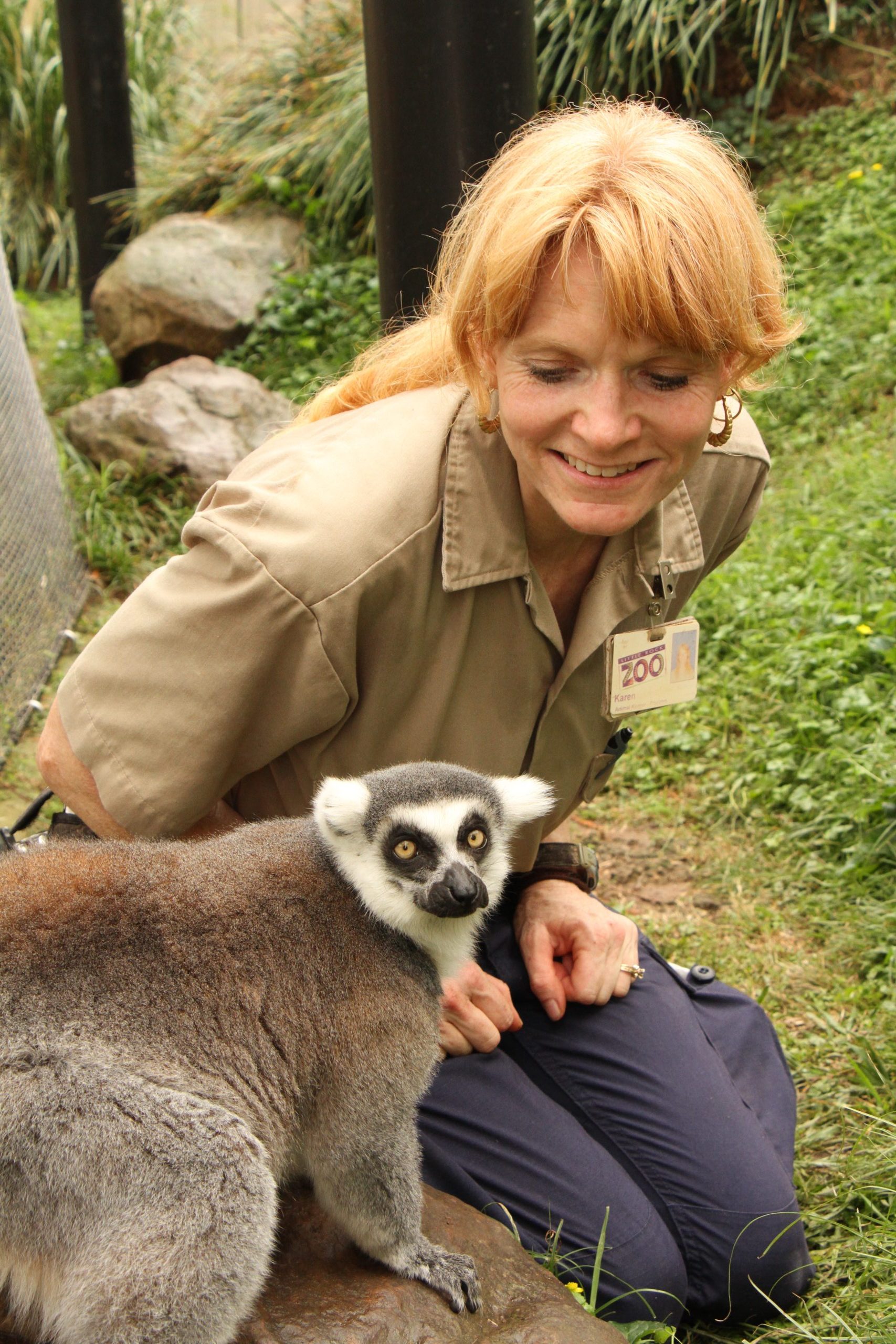
Karen with Bandit, a ring-tailed lemur who was formerly kept as a pet.
Karen remembers this becoming especially clear when the Zoo first began introducing different lemur species to one another. The animals had never lived with another lemur species before and didn’t immediately understand one another’s vocalizations and behaviors.
They had to learn.
And eventually, they did.
Those are the kinds of details keepers spend their careers learning to recognize.
Something else that sometimes surprises guests? The animals know their keepers, too.
“We work with these individuals five days a week most weeks of the year,” Karen said. “They see us all the time. We feed them, medicate them, train them, clean their habitats.”
Those relationships can extend beyond an animal’s primary care team. Karen walks past animals like the Zoo’s lions and rhinoceroses regularly, and she says they recognize both her appearance and her voice.
For a keeper, knowing the animals—and allowing them to know you—is something built over time.
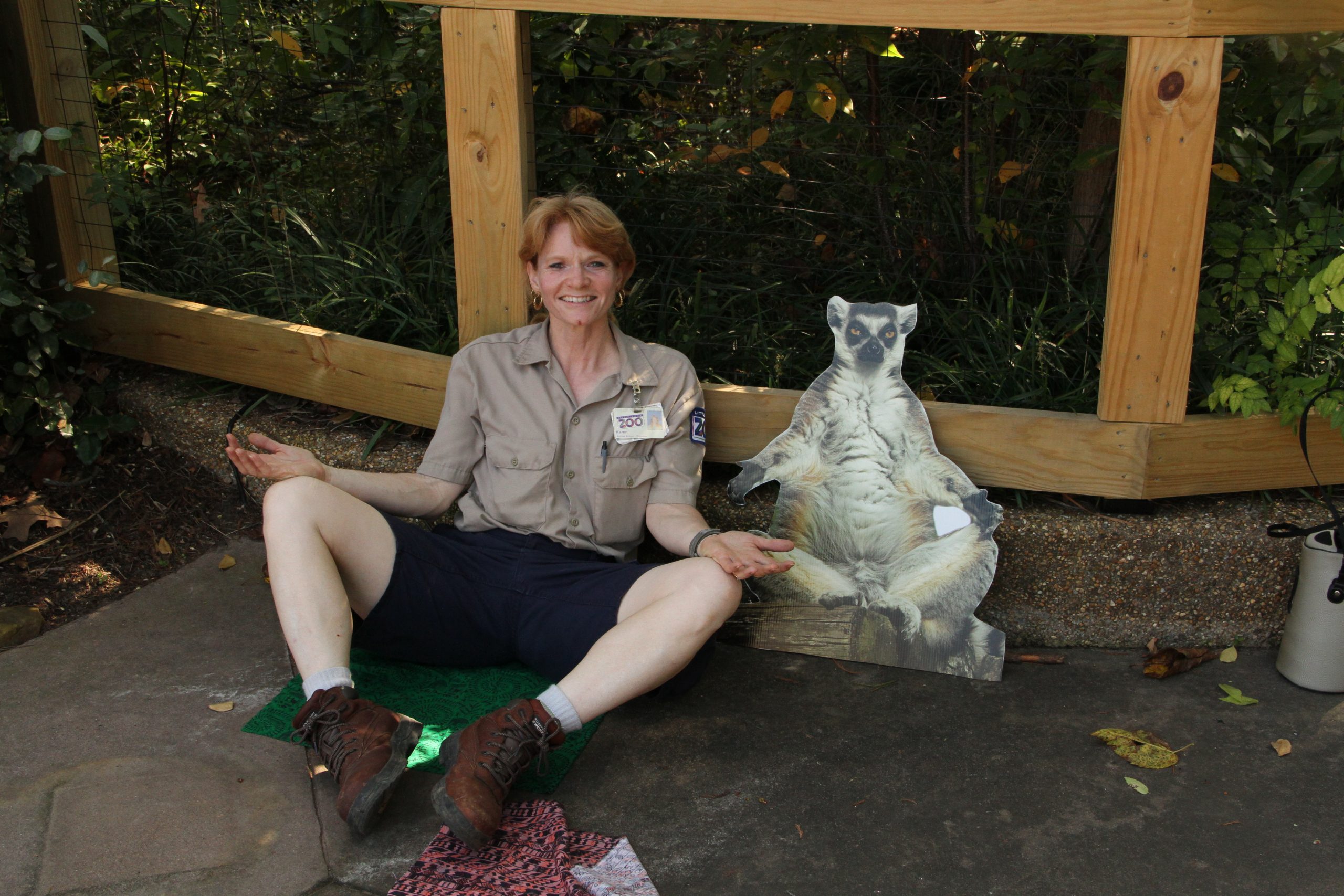
Karen striking a classic lemur sunning pose alongside a cutout of Todd the lemur in 2016.
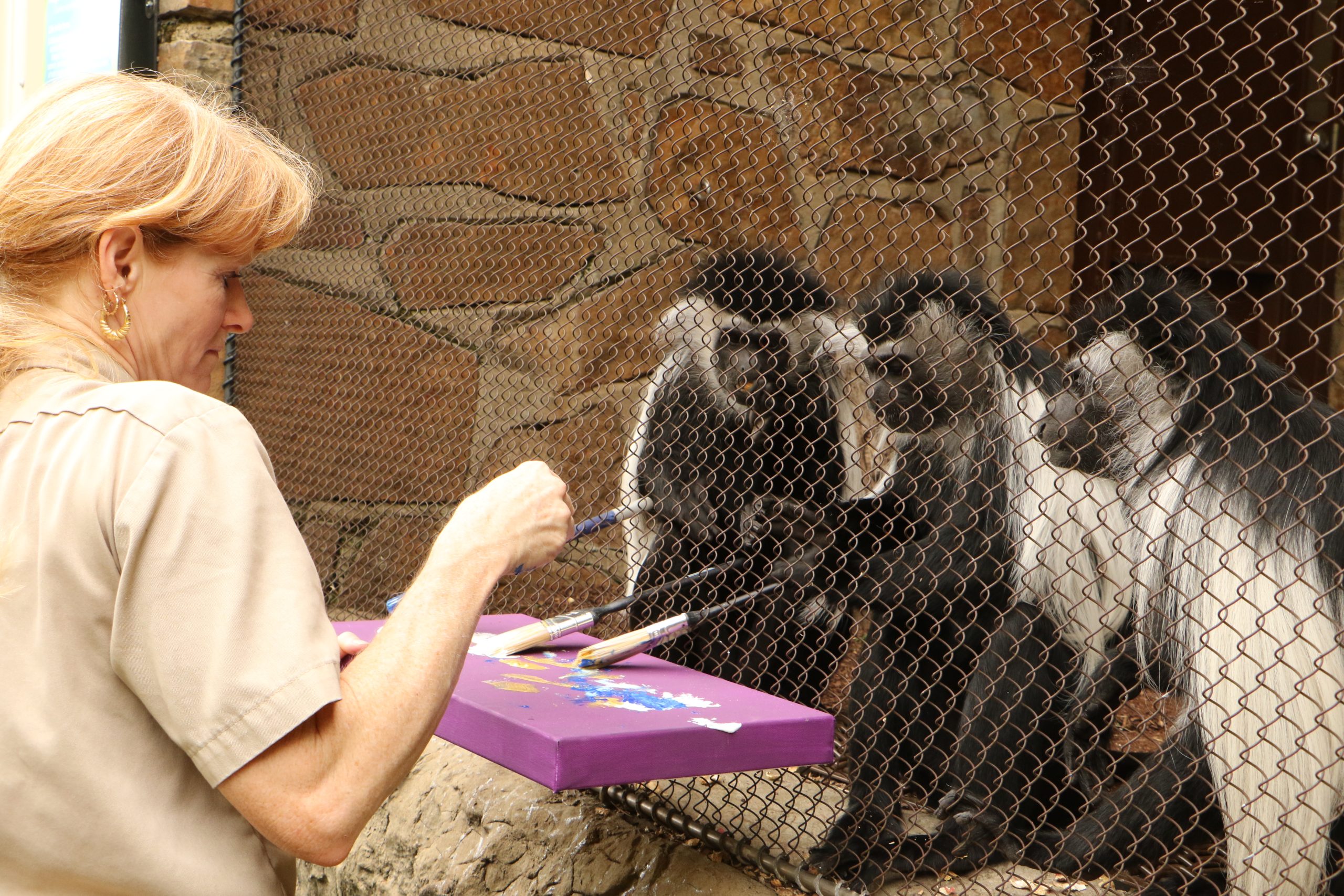
Karen participating in a painting enrichment activity with the colobus monkeys in 2019.
What a Zookeeper’s Day Really Looks Like
A typical day begins with checking emails and daily reports before loading diets, checking animals and administering medications.
Then comes cleaning habitats, preparing enrichment, feeding, training and shifting animals into their habitats for the day. Indoor holding areas need to be cleaned, too, and animals remaining behind the scenes still need food, enrichment and attention.
And that’s usually just the morning.
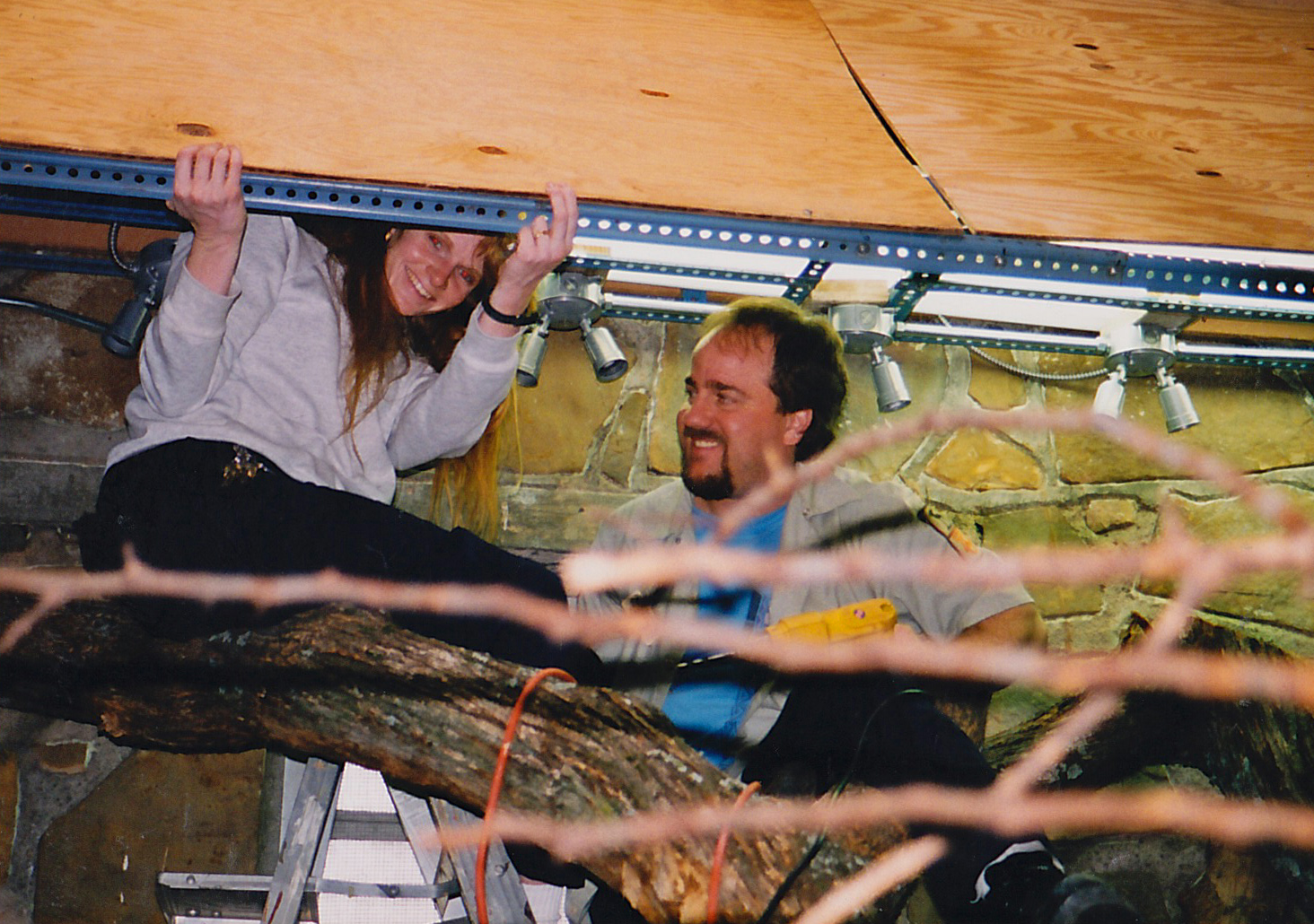
Karen building a light structure in the Linder exhibit in 1998.
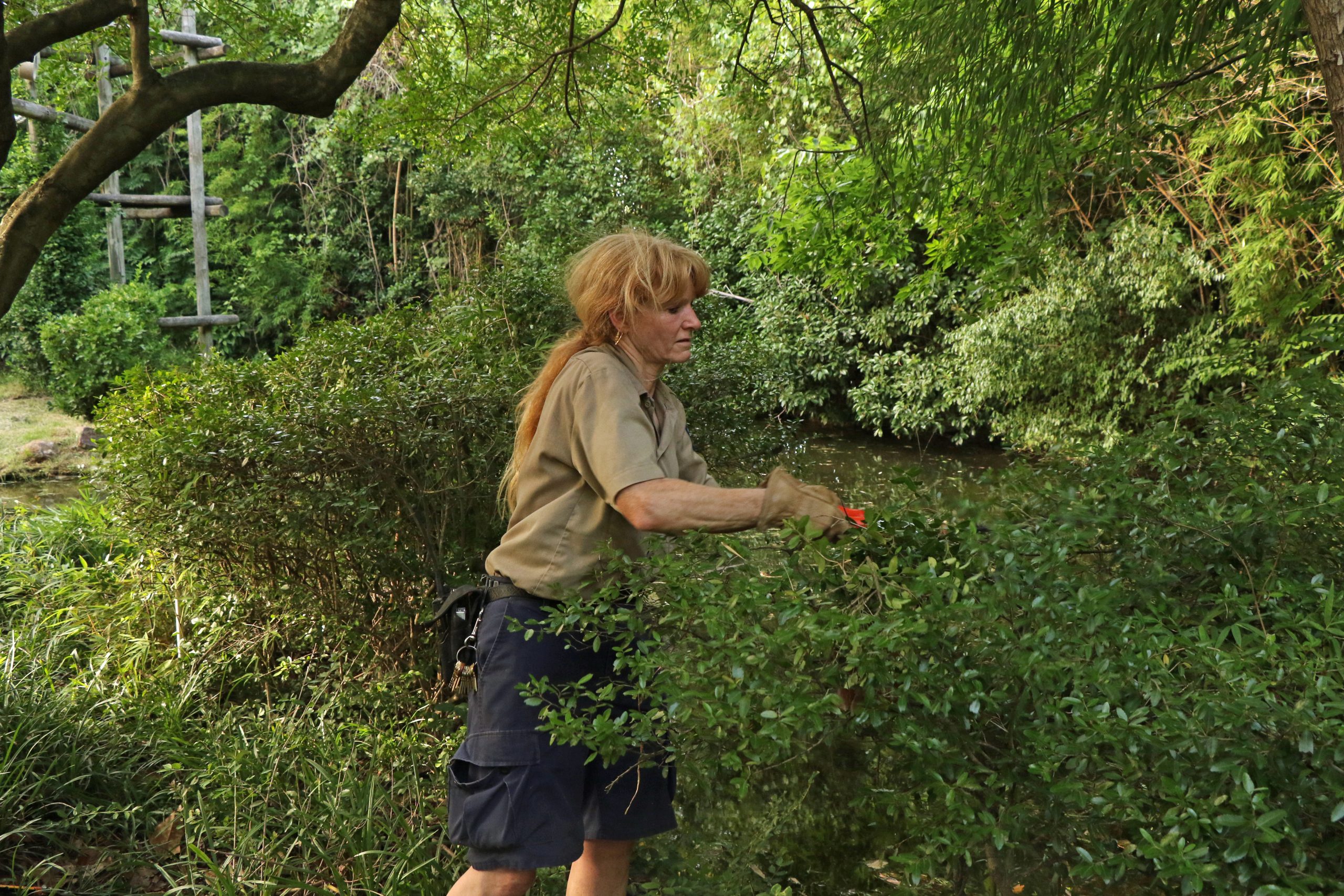
Karen performing exhibit maintenance in 2022.
Afternoons can include additional feedings, training sessions, animal care projects, meetings, recordkeeping and planning before the evening routine begins. Animals may receive additional medications, food and enrichment before final checks are completed and areas are secured for the night.
Behind all of that daily work is another layer guests rarely see: planning.
Accredited zoos work together to manage animal populations cooperatively. Animal care professionals consider genetics, social needs, available space, breeding recommendations and the long-term needs of individual animals and populations.
Facilities must consider not only whether they want to participate in breeding programs, for example, but also whether they have the resources and space to care for offspring for as long as needed.
It’s a level of coordination that may not be obvious during a walk through the Zoo, but it plays an important role in the care guests see every day.
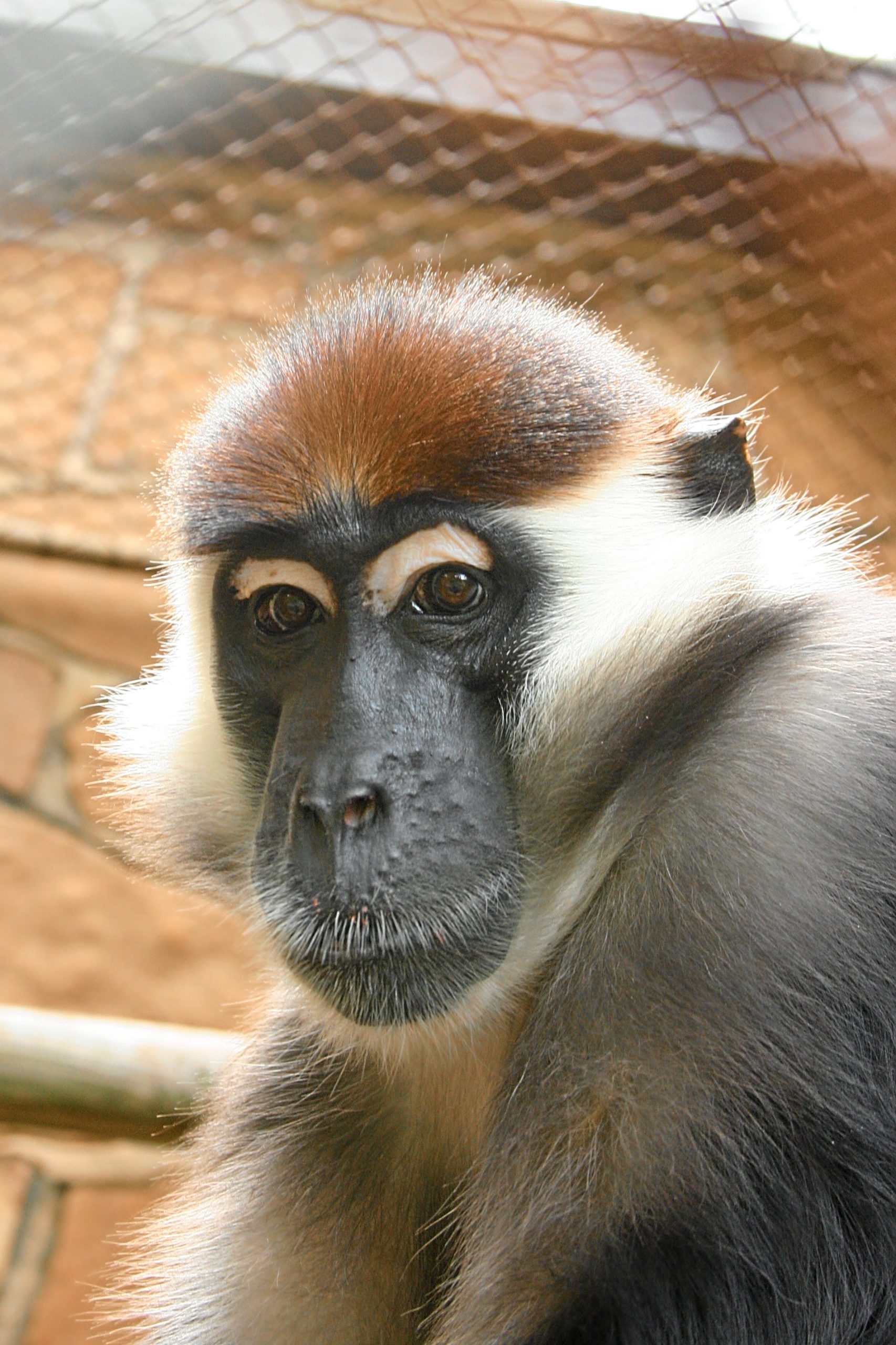
Moses, the red-capped mangabey.
Relationships Built Over Time
When asked to choose one animal who has made a particularly meaningful impact on her career, Karen admits it’s almost impossible.
“Oh, my goodness, there are really so many!” she said.
But one eventually comes to mind: Moses, a red-capped mangabey.
When Moses arrived at the Little Rock Zoo, Karen describes him affectionately as a “punk teenager”—full of attitude and challenging to work with.
“We both had to learn the art of compromise in those early days,” she said.
Over time, that difficult beginning developed into one of the most meaningful animal-keeper relationships of Karen’s career.
Moses excelled at voluntary training and even developed behaviors of his own. Karen would notice him doing something new, recognize the behavior and eventually put it on cue.
He also had plenty of personality.
At Christmastime, Moses and fellow mangabey, Holly, would get excited when a Christmas tree appeared near their building. On Christmas Day, they received wrapped boxes containing treats.
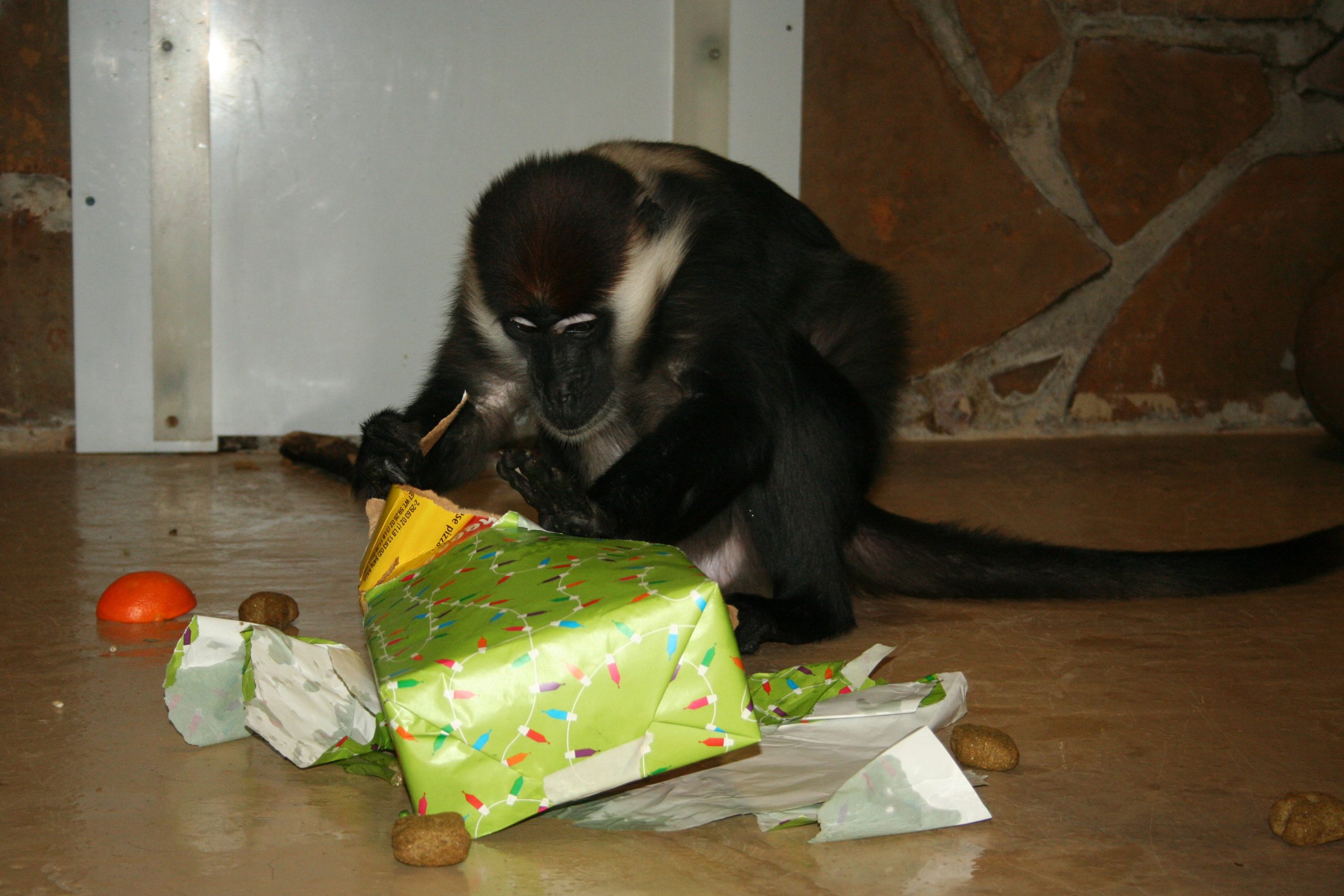
Moses, enjoying Christmas present enrichment.
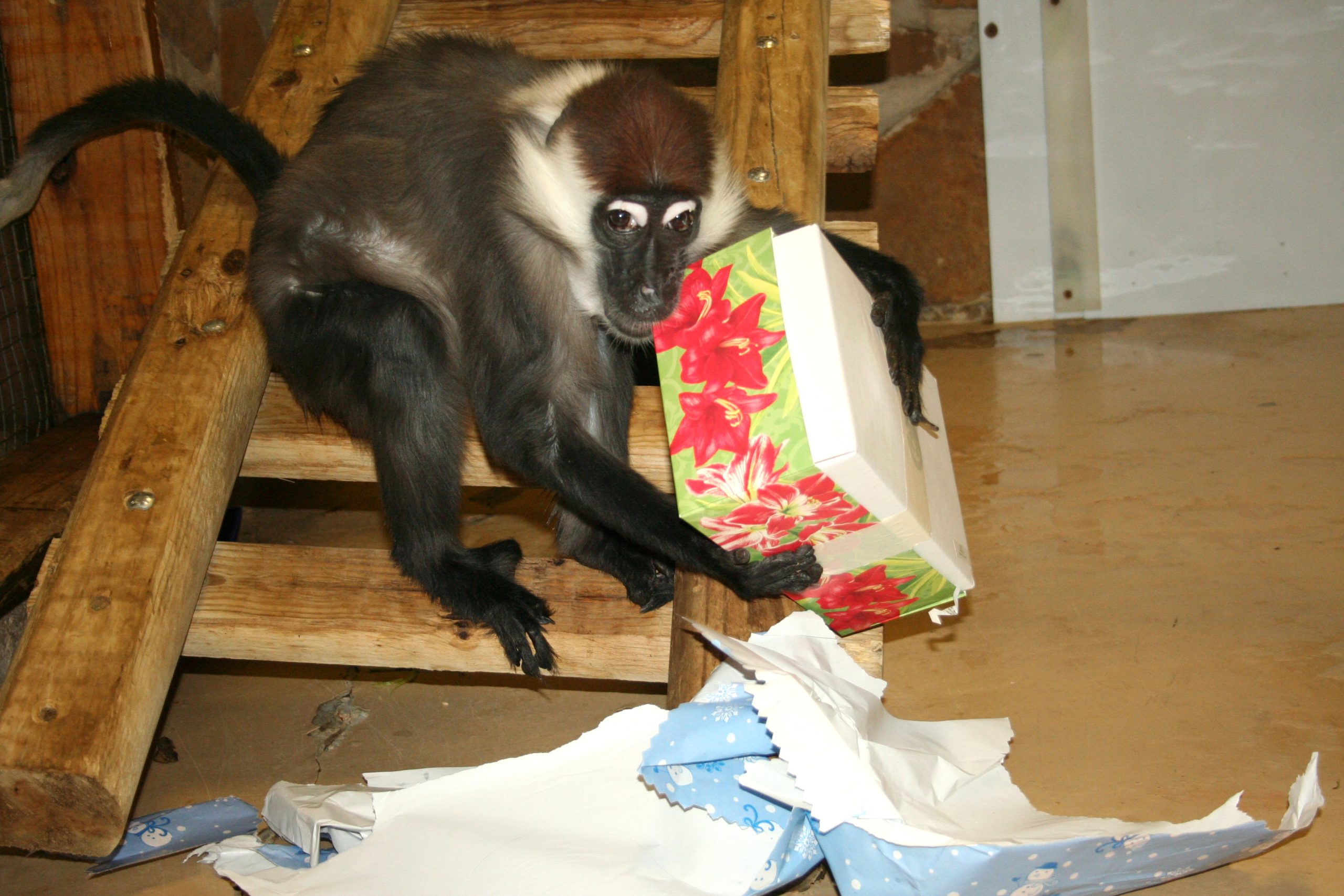
Holly, with her Christmas present enrichment.
Moses was even fascinated by his own reflection. While male mangabeys may respond aggressively to their reflections, Moses would spend time lip-smacking at himself—a friendly social behavior.
When Moses developed diabetes, the relationship and training Karen had built with him became especially important. He voluntarily participated in receiving insulin injections in exchange for a particularly unusual reward: a tiny bit of mustard with hot sauce.
“He loved spicy things,” Karen said.
For Karen, their relationship represented something at the heart of good zookeeping: trust isn’t automatic. It is built through patience, consistency, observation and time.
“I think one of the things that made this relationship so special was the time it took to build,” she said. “It started out very rough but became something so deep and meaningful.”
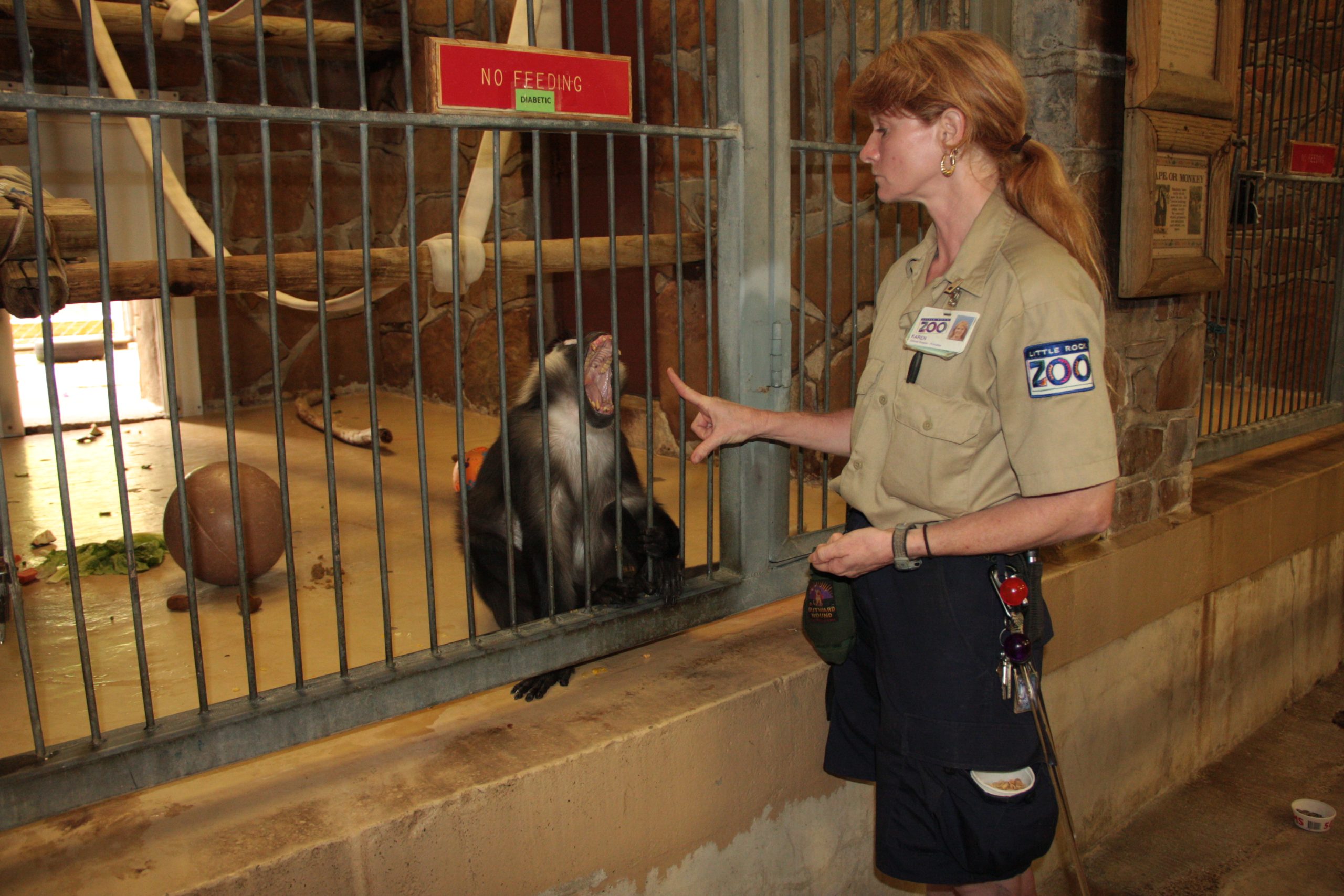
Karen working on training with Moses.
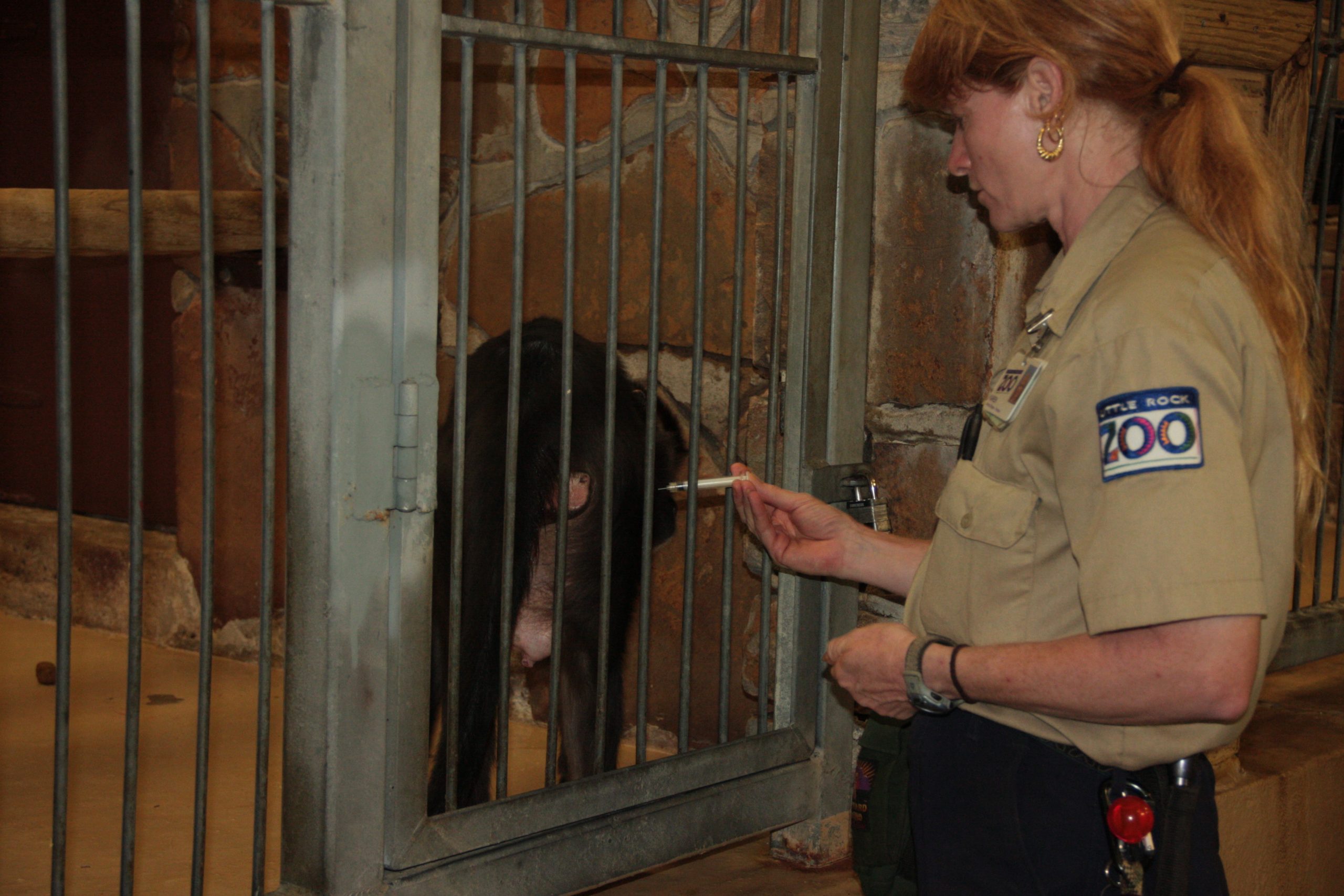
Karen administering a voluntary injection to Moses—a remarkable example of the trust and dedication built through years of patient training and care.
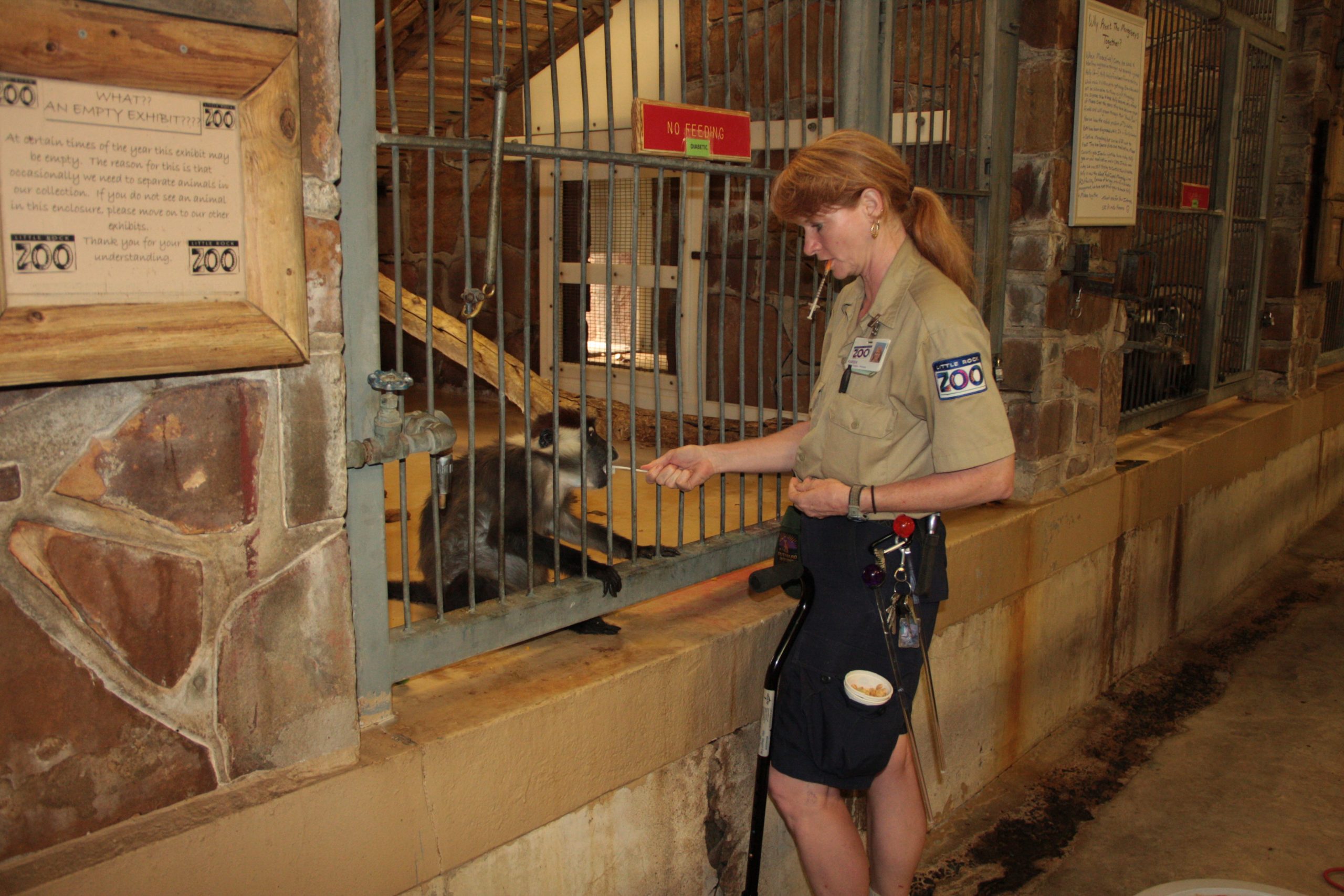
Karen working with Holly on voluntary toothbrushing training.
Watching the Profession Grow
Karen’s 30 years at the Zoo have also allowed her to watch animal care itself continue to evolve.
When she began, the Zoo didn’t have a formal enrichment program. Karen and another keeper helped start one in the Small Primates area.
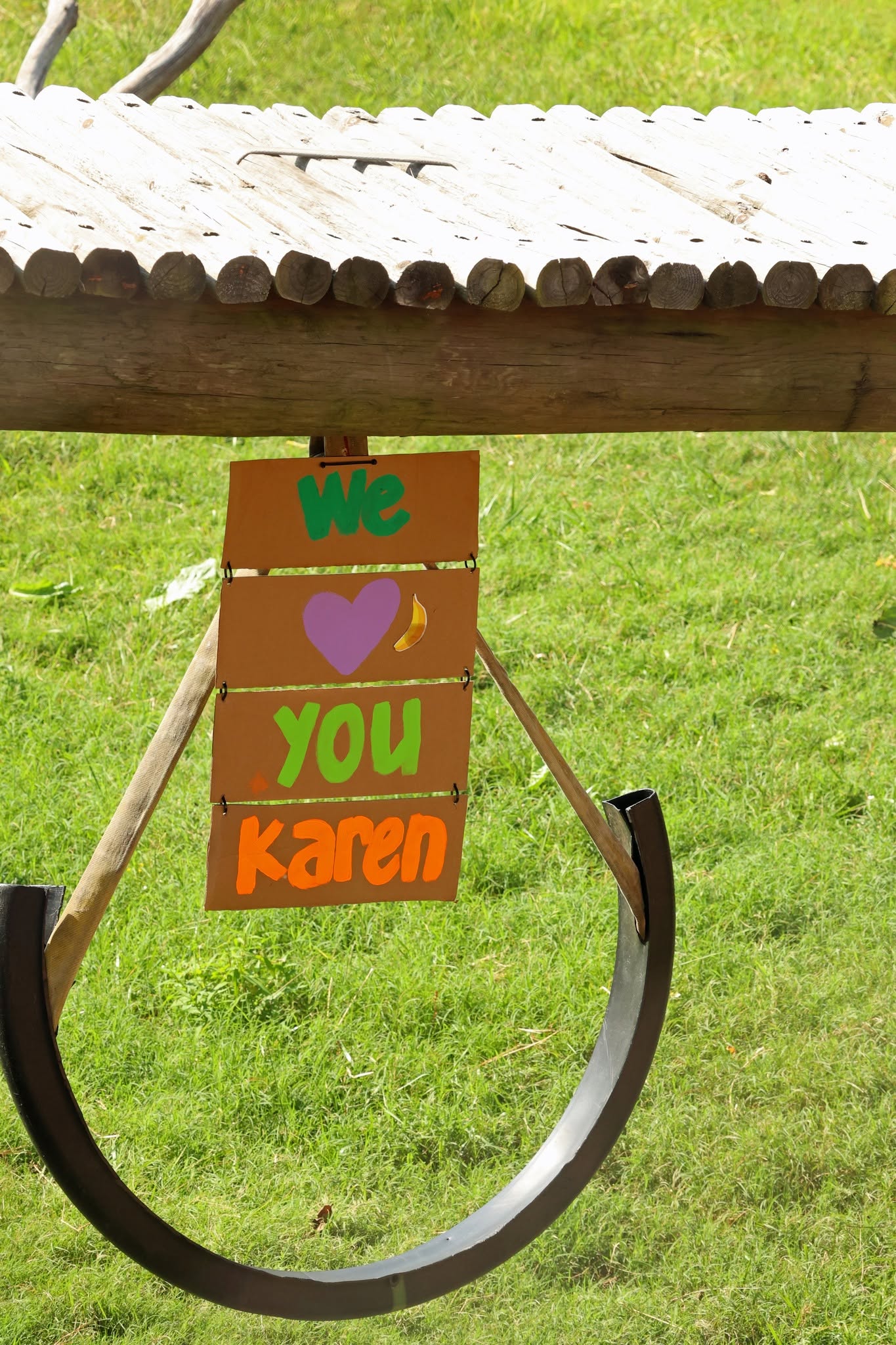
Special gorilla enrichment celebrating Karen’s years of dedication and care.
Today, enrichment is an important part of modern zoo animal care, providing animals with opportunities to make choices, solve problems, explore and engage in species-appropriate behaviors.
“I am soooo grateful I got in on the ground floor of enrichment,” Karen said.
She remembers watching animals encounter new types of enrichment and having to figure out concepts they’d never experienced before.
“It really made them think outside the box they were used to,” she said.
Some of Karen’s favorite enrichment remains deceptively simple.
For larger primates, it might be food scattered through piles of leaves, encouraging them to spend time searching and foraging. Smaller primates may receive mop heads filled with mealworms. Both can keep animals engaged for long periods as they search through the material for food.
The goal isn’t simply to give an animal something new. It’s to encourage natural behaviors and provide meaningful opportunities to interact with their environment.
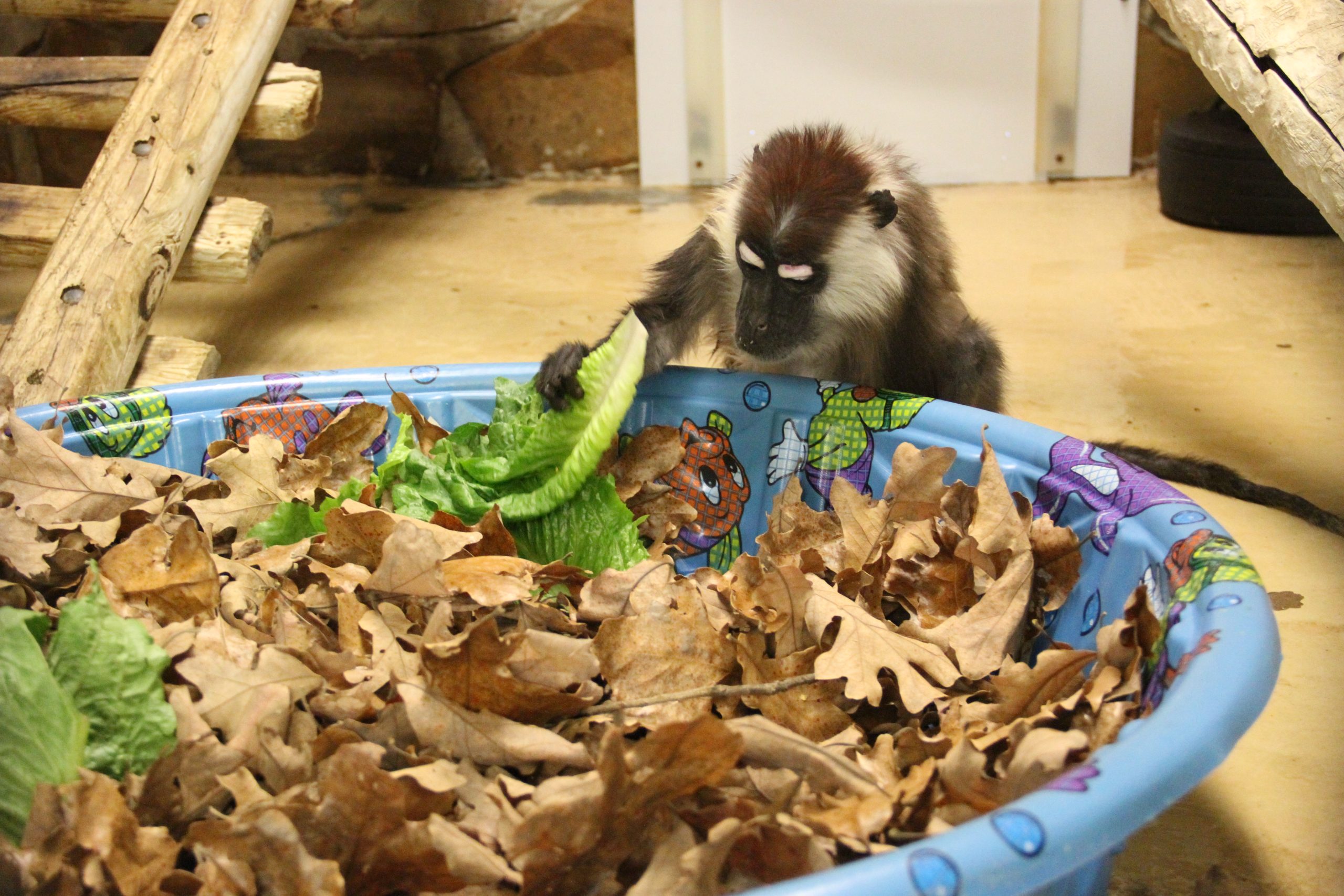
Holly foraging through a pile of leaves as part of her enrichment activities.
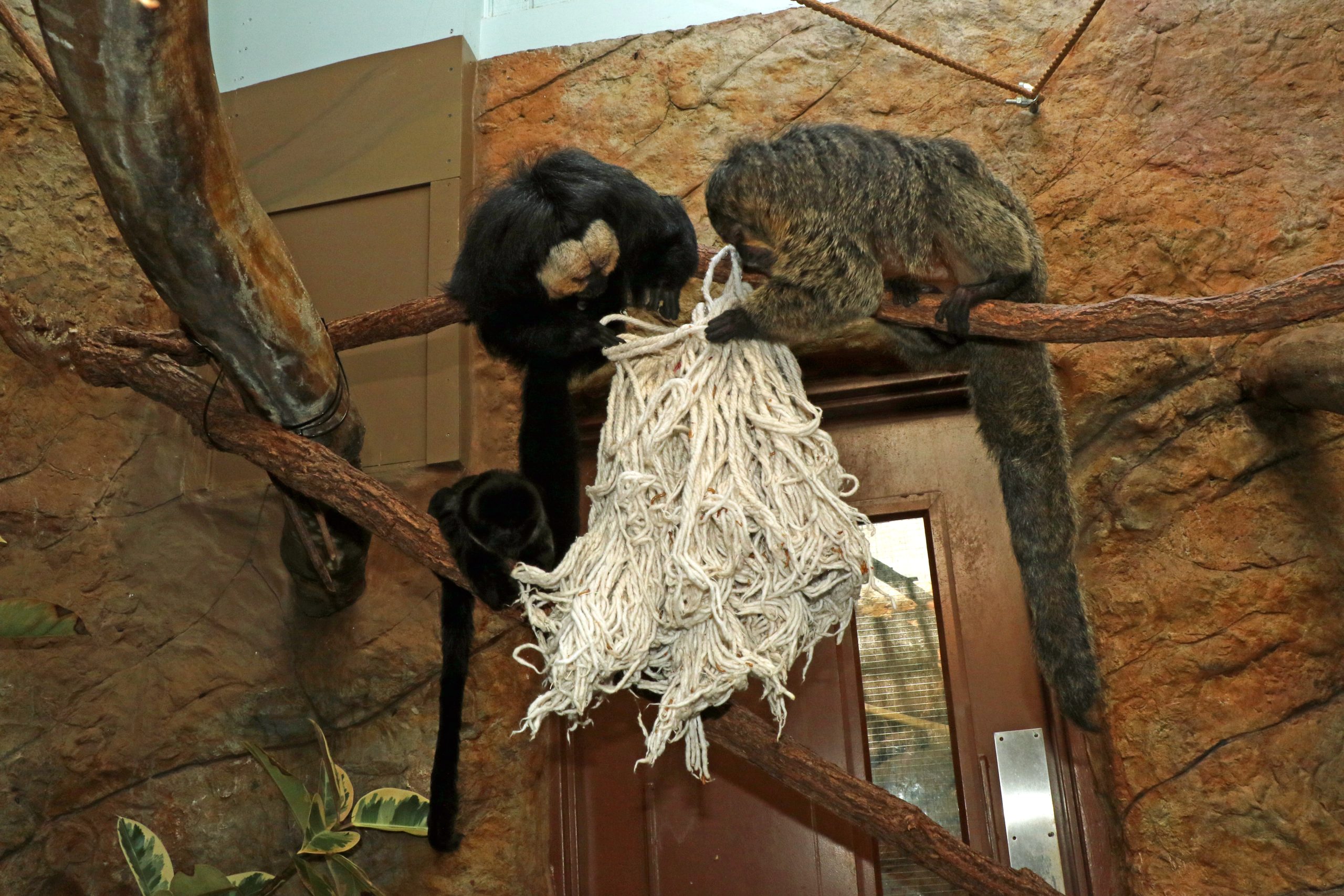
Saki monkeys exploring mop head enrichment, which encourages natural grooming and foraging behaviors as they search through the fibers for insects.
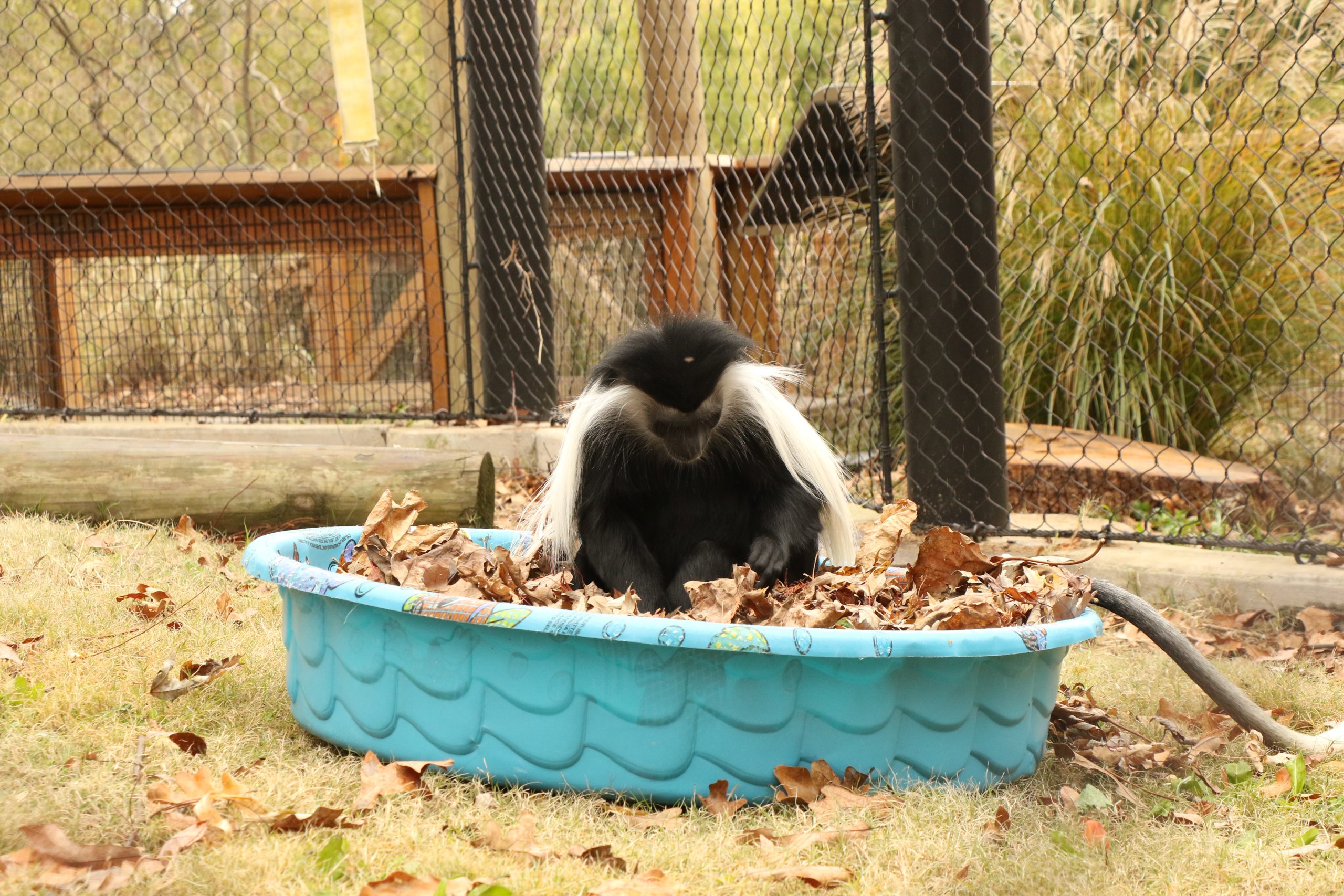
A colobus monkey foraging through a pile of leaves.
Thirty Years of Unforgettable Moments
Ask Karen for her favorite memory, and choosing just one becomes impossible.
There was opening the Zoo’s original lemur exhibit—her first new habitat—and now, years later, watching a new and larger lemur habitat take shape.
There was hand-raising Murphy the gibbon for five months before successfully transitioning him to his grandmother, Land, who took over raising him.
There was watching the spider monkey troop navigate changing social dynamics after losing its dominant male.
There have been babies, successful introductions, breakthroughs in training, difficult losses and unexpected emergencies.
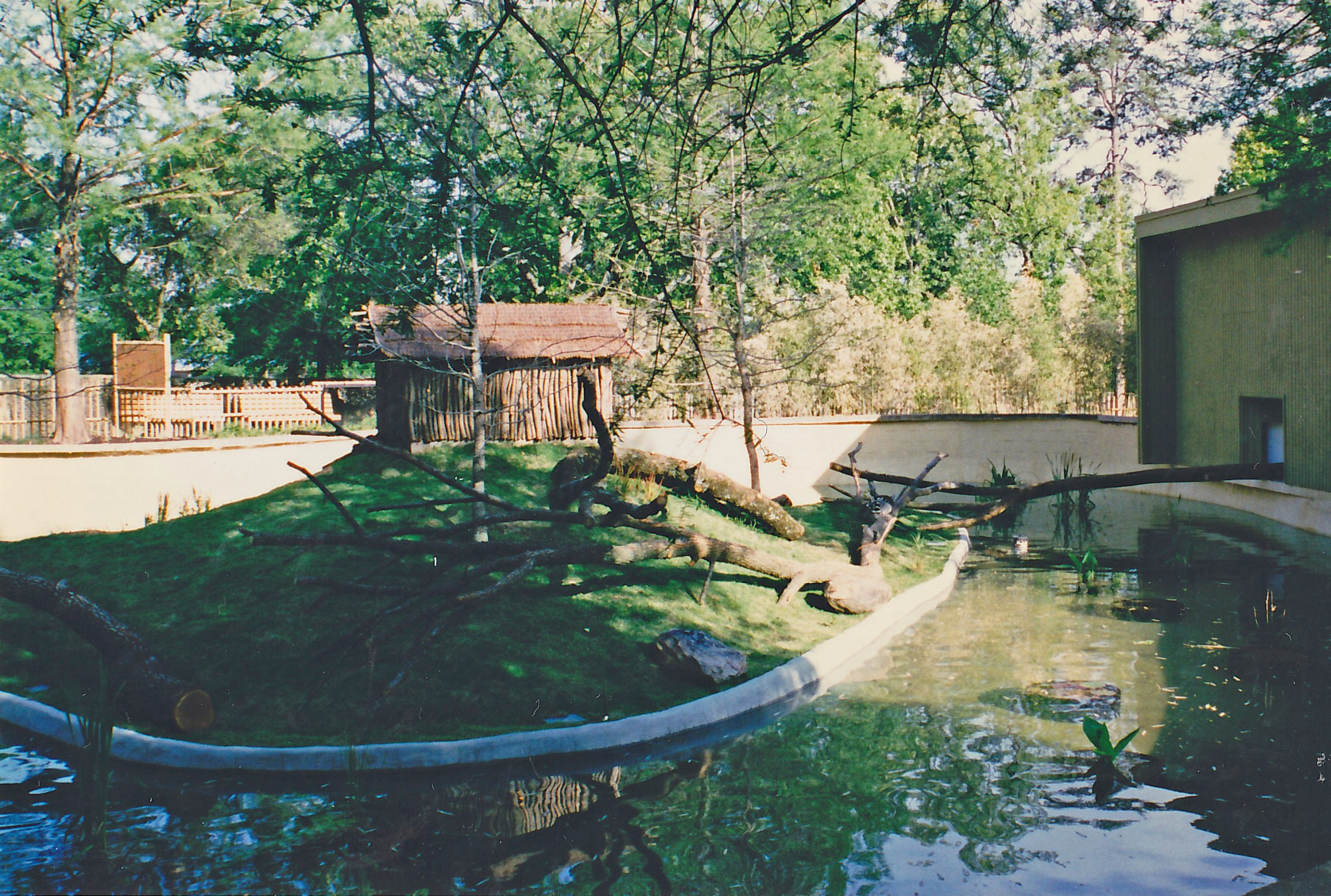
New Lemur Island shortly after opening in 1997.
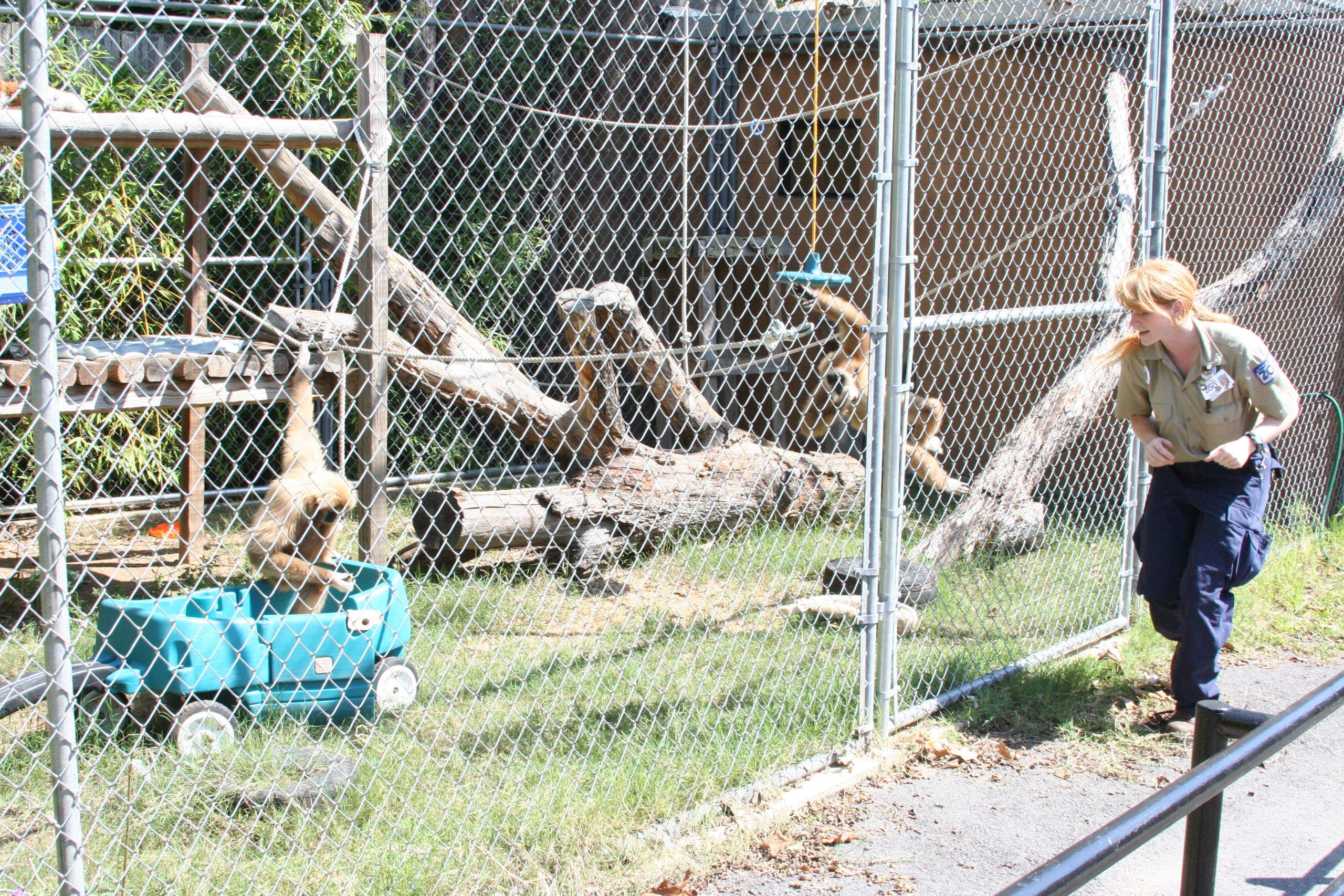
Karen playing chase with Murphy the gibbon in 2007.
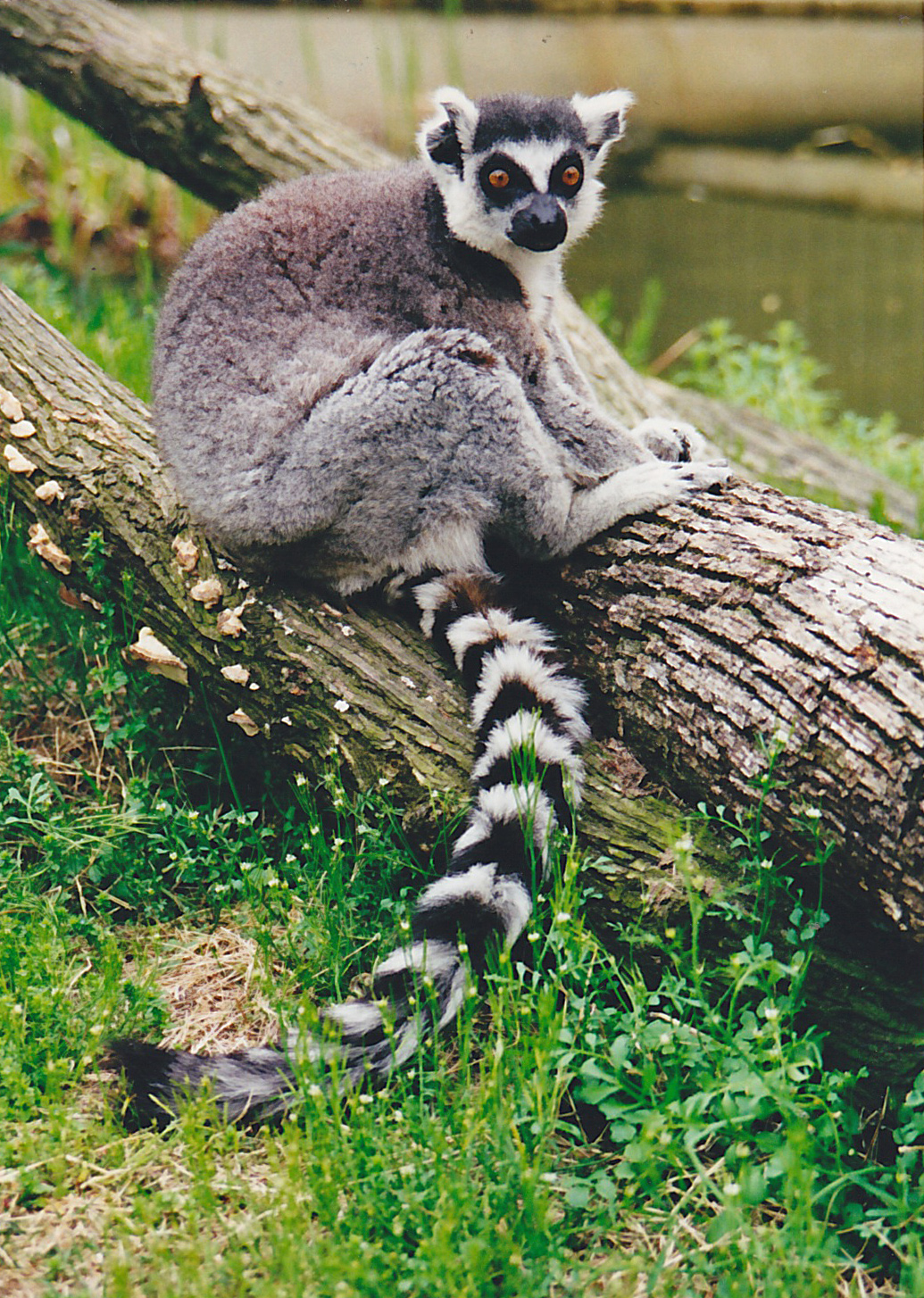
One of Karen’s favorite photos of Jerry, a ring-tailed lemur she nicknamed “Switzerland” for his calm, neutral demeanor during introductions between different lemur species.
And there are the smaller moments that stick with a keeper just as strongly.
During one of the Zoo’s early mixed-species lemur introductions, Karen remembers red ruffed lemurs and black lemurs posturing and threatening one another. Jerry, a ring-tailed lemur, simply walked between the groups, sat down and calmly remained there until everyone settled.
Karen started calling him “Switzerland.”
Then there was Land, a gibbon whose early life before arriving at the Zoo had left her understandably wary of people. Years later, Karen helped hand-raise Land’s grandson, Murphy, before successfully transitioning him into her care.
Land accepted him.
“She did a fantastic job raising him,” Karen said.
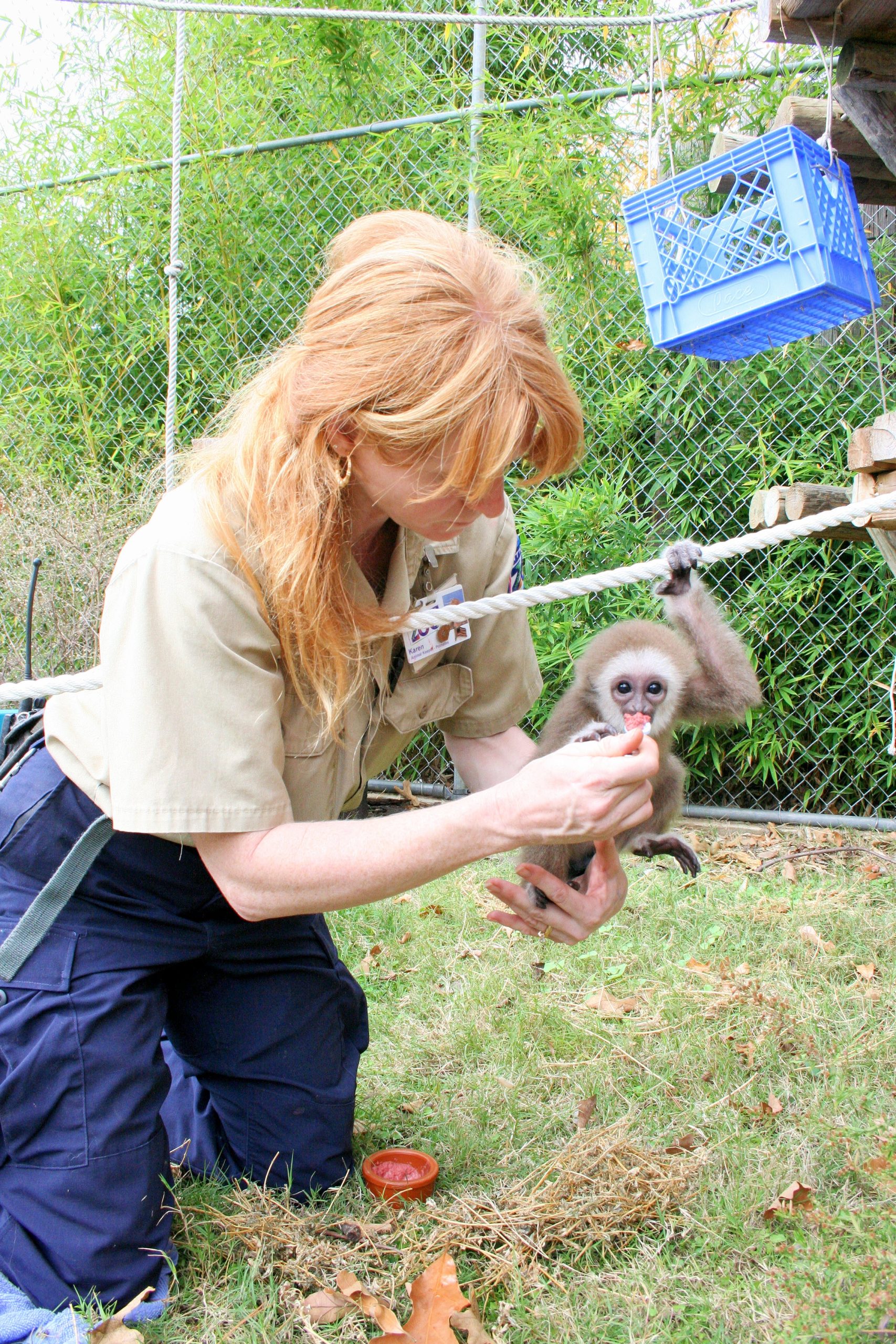
Karen feeding Murphy the gibbon as a baby.
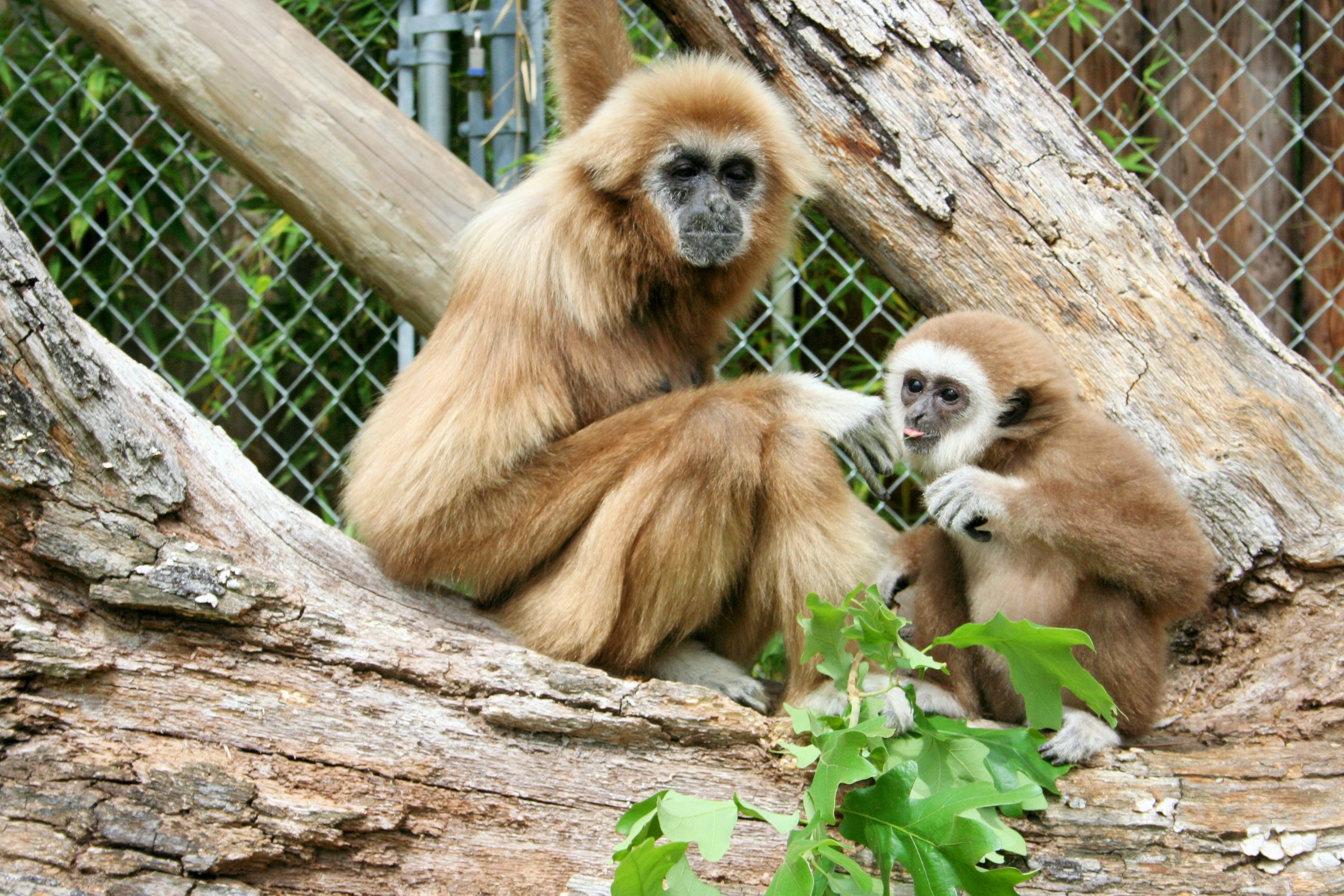
Murphy the gibbon with his grandmother, Land, who took over his care after Karen helped hand-raise him as an infant.
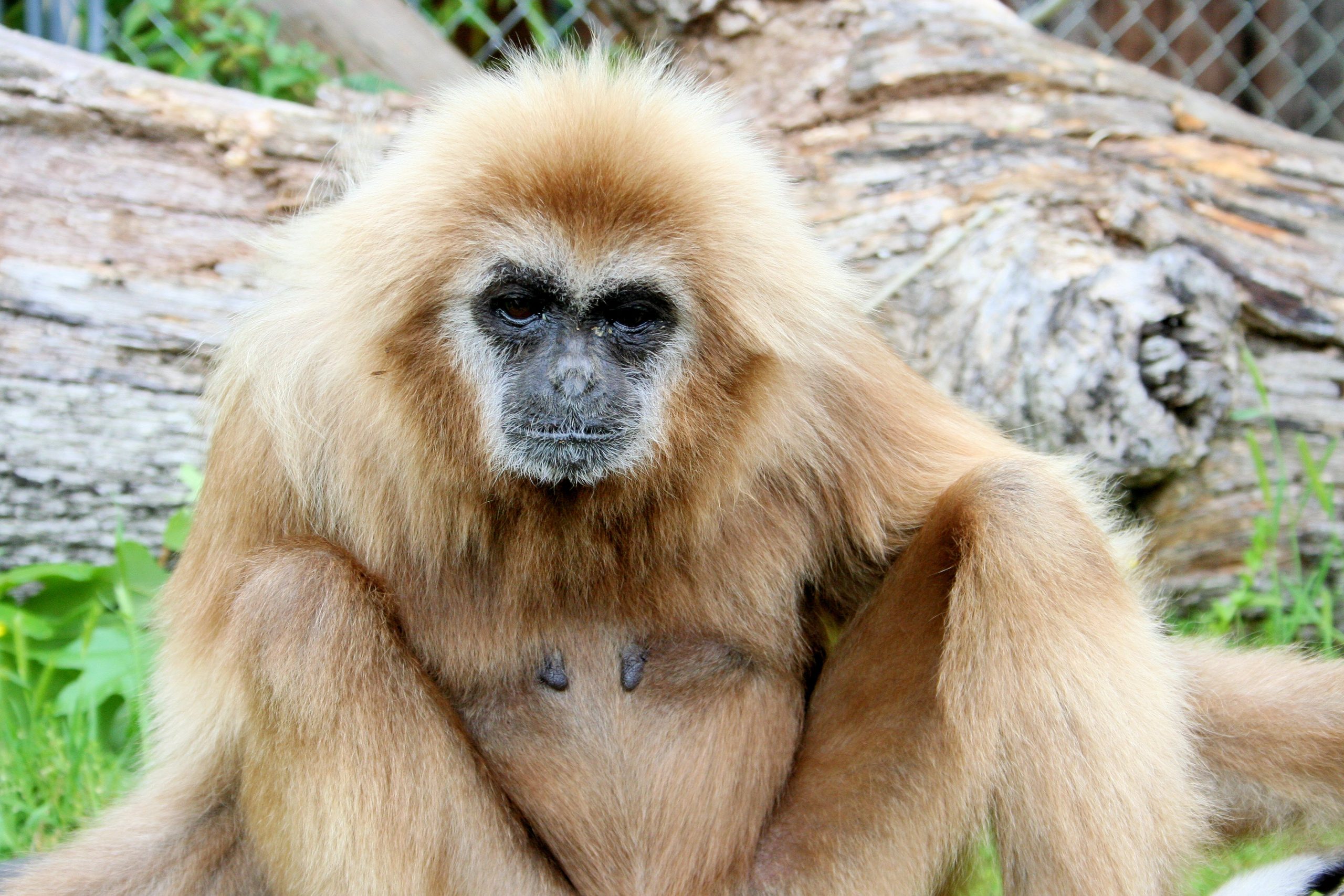
Land the gibbon, Murphy’s grandmother.
Thirty years later, those individual personalities and relationships remain what Karen treasures most.
“I am so incredibly fortunate to have experienced and seen so many different things,” she said. “I never take it for granted how special it all is.”
“I have a front-row seat into the lives of so many incredible species and individuals. That is truly an amazing thing.”
So, You Want to Be a Zookeeper?
For anyone dreaming about following in Karen’s footsteps, she has some practical advice.
Start with education.
A bachelor’s degree, particularly in an animal- or science-related field, is commonly preferred. Then get as much hands-on animal experience as possible.
Zoo and sanctuary internships can be especially valuable, both for building practical experience and preparing for future job opportunities.
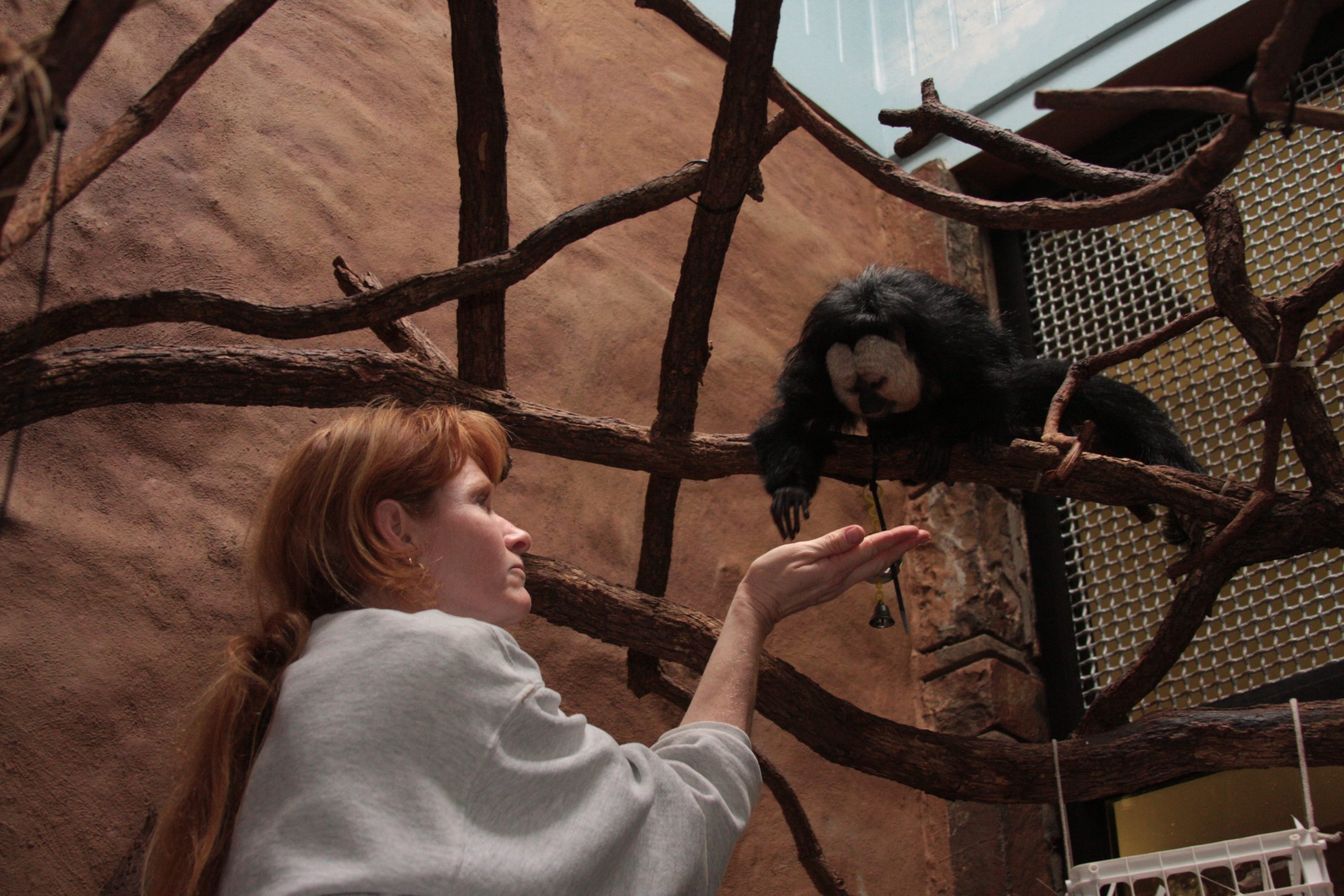
Karen feeding Wassail the Saki monkey in 2007.
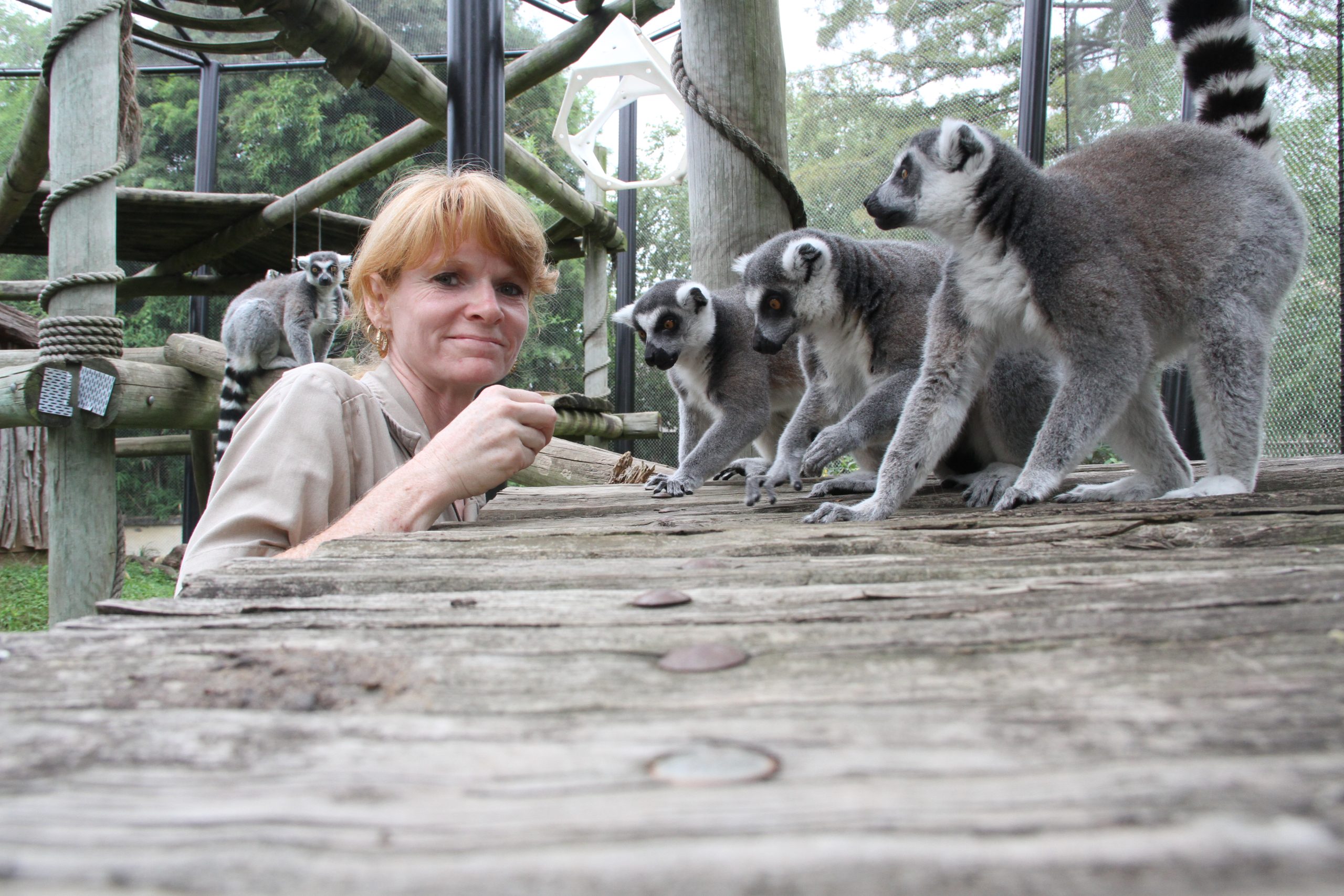
Karen with ring-tailed lemurs Todd, Karesh, Linus, and Pepper in 2013.
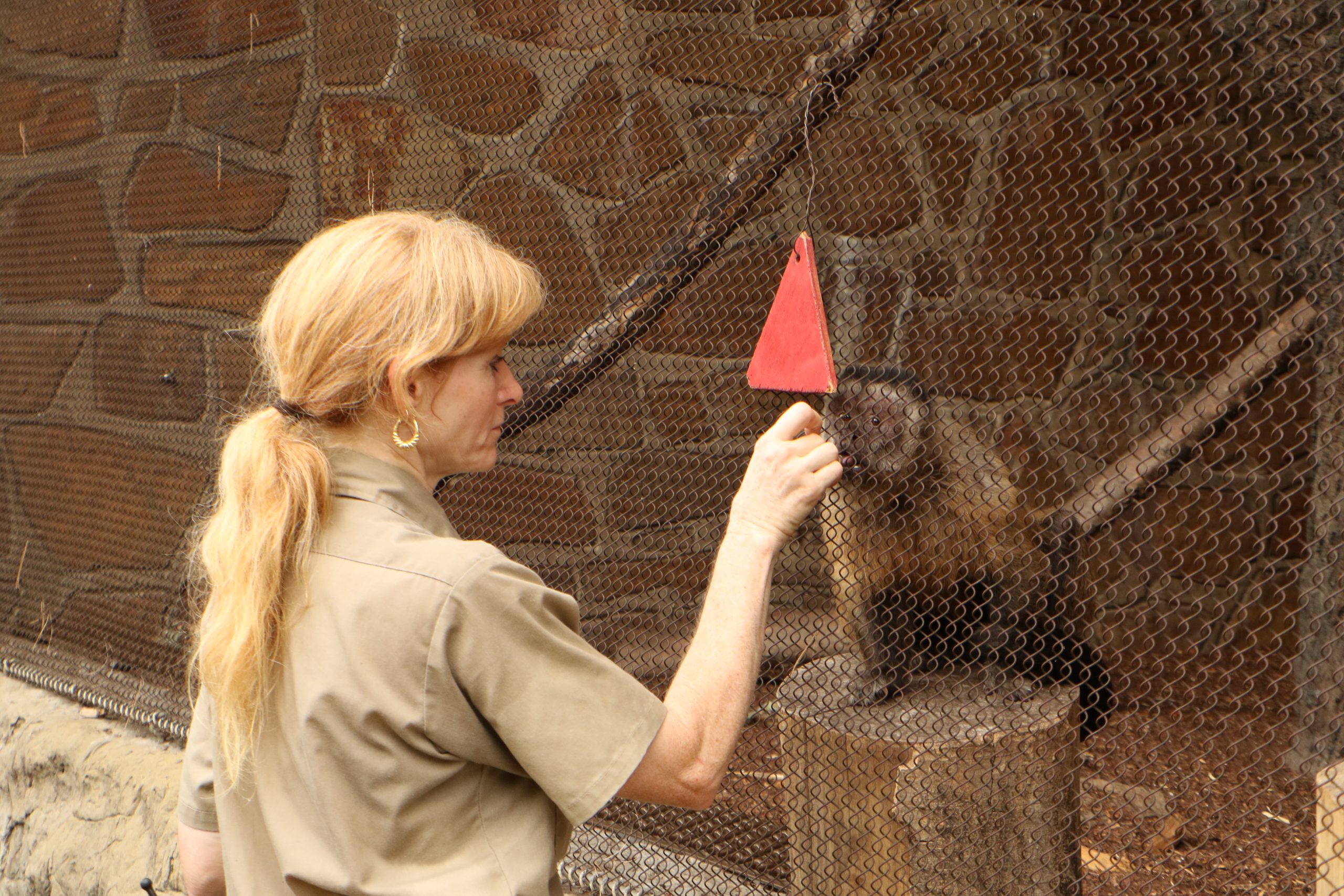
Karen working on training with M’yan the Capuchin monkey in 2018.
Aspiring keepers should also build skills that might not immediately come to mind when imagining a zoo career: cleaning, following detailed instructions, noticing subtle behavioral or physical changes, communicating with a team and even using programs such as Excel.
Then, be patient and persistent.
Zookeeping is a competitive profession, and landing that first position may take time.
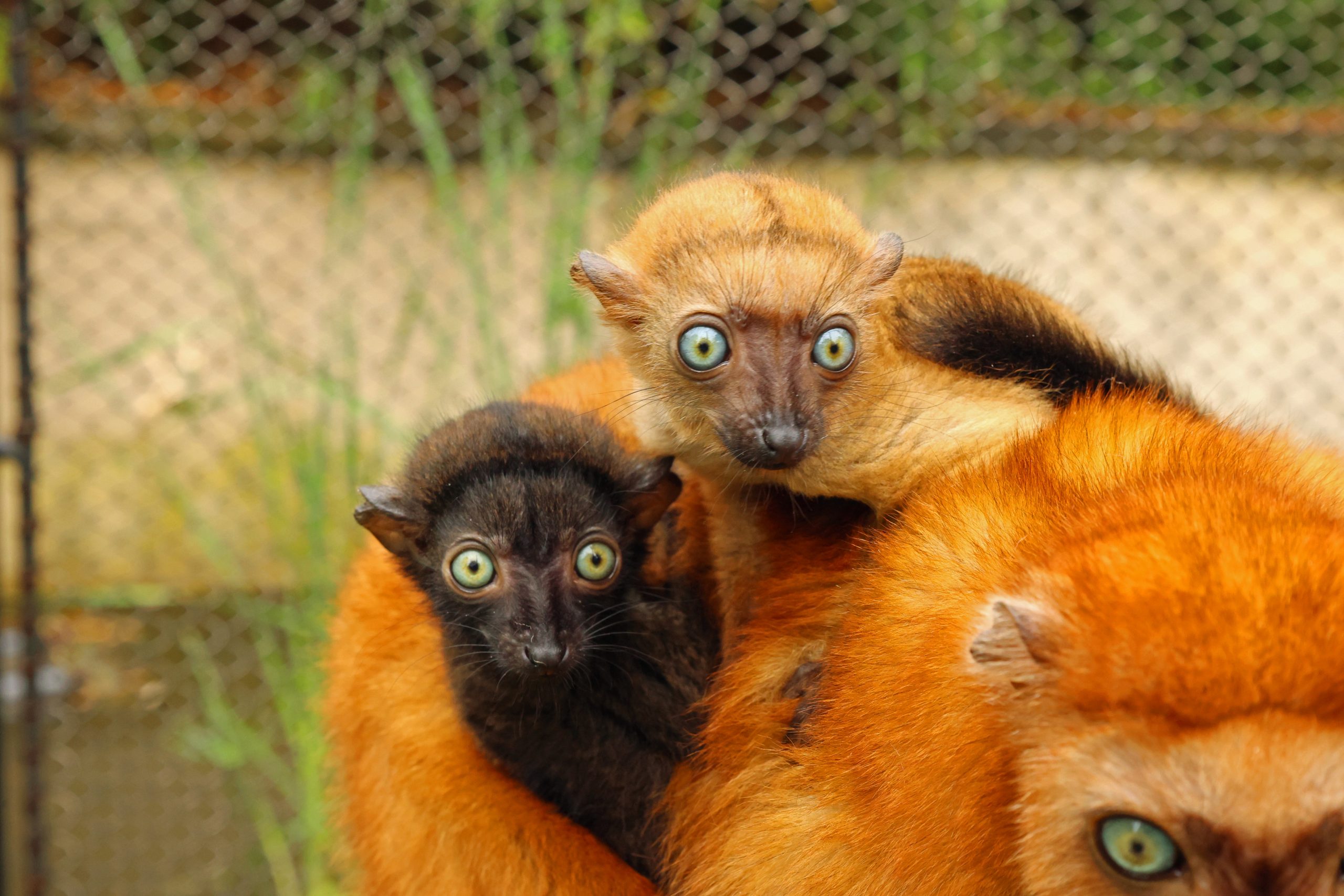
Radcliff and Swift Blue Eyed Black Lemurs born at the Little Rock Zoo.
“Don’t get discouraged if you don’t get a position right away,” Karen said.
Prospective keepers should also understand the realities of the career. The work is physical. Weekends and holidays are part of the job because animals need care every day of the year.
“Expect to work hard, work holidays and at least part of a weekend and never be rich,” Karen said. “If all that is okay, the rewards you get from the animals are so worth it!”
Still Excited to Come to Work
Three decades into her career, Karen still doesn’t hesitate when asked what makes her excited to come to work.
The animals.
“I know I sound like a broken record,” she said, “but the animals. I really am so grateful to be a part of their lives.”
She still enjoys the physical nature of the work, too, and the variety that comes with working at a zoo where keepers learn to do a little bit of everything.
“No two days are the same,” she said. “There are the basics in your daily routine, but there are always variations and things that come up.”
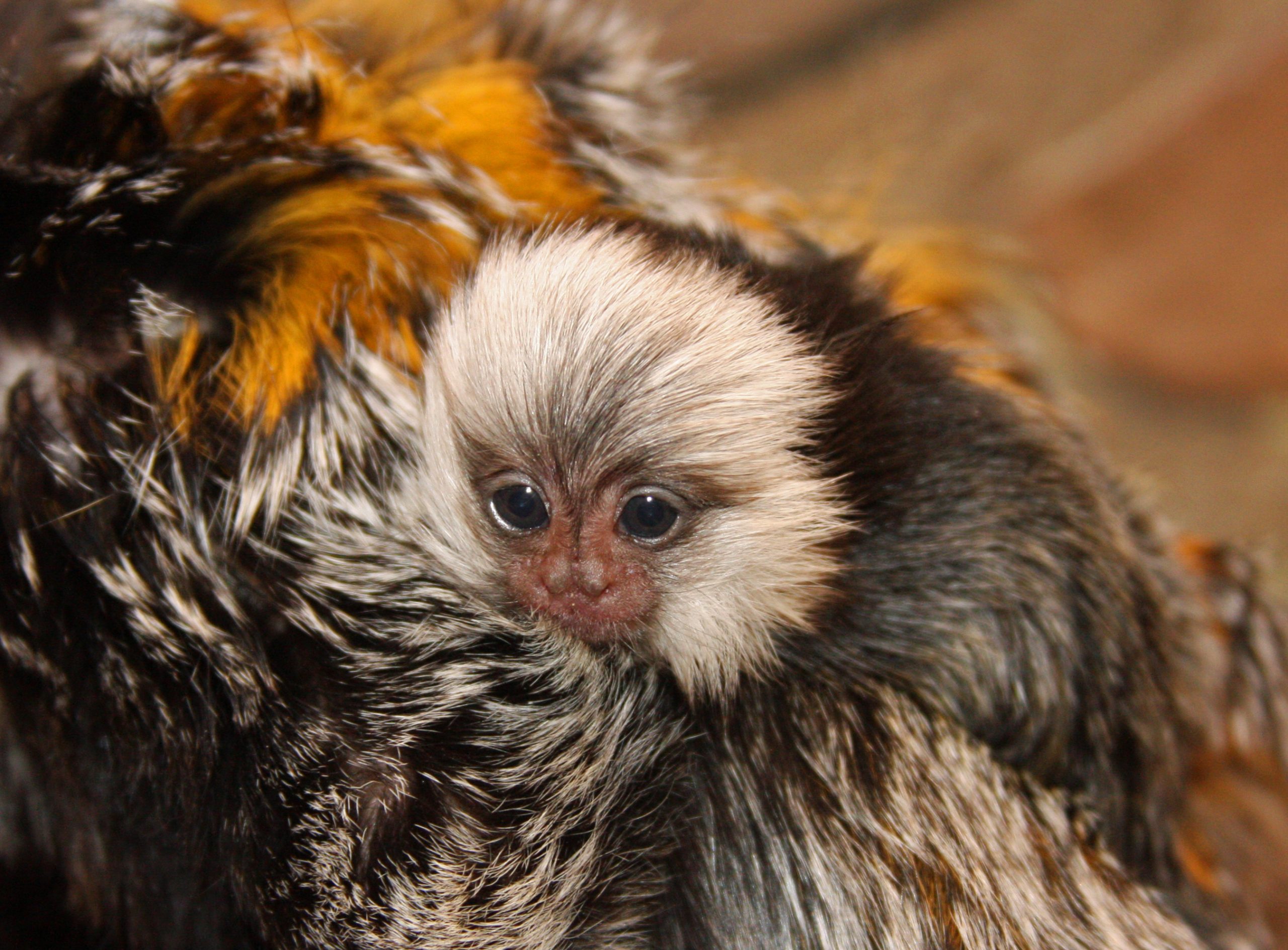
Carlos, a baby marmoset, in 2010.
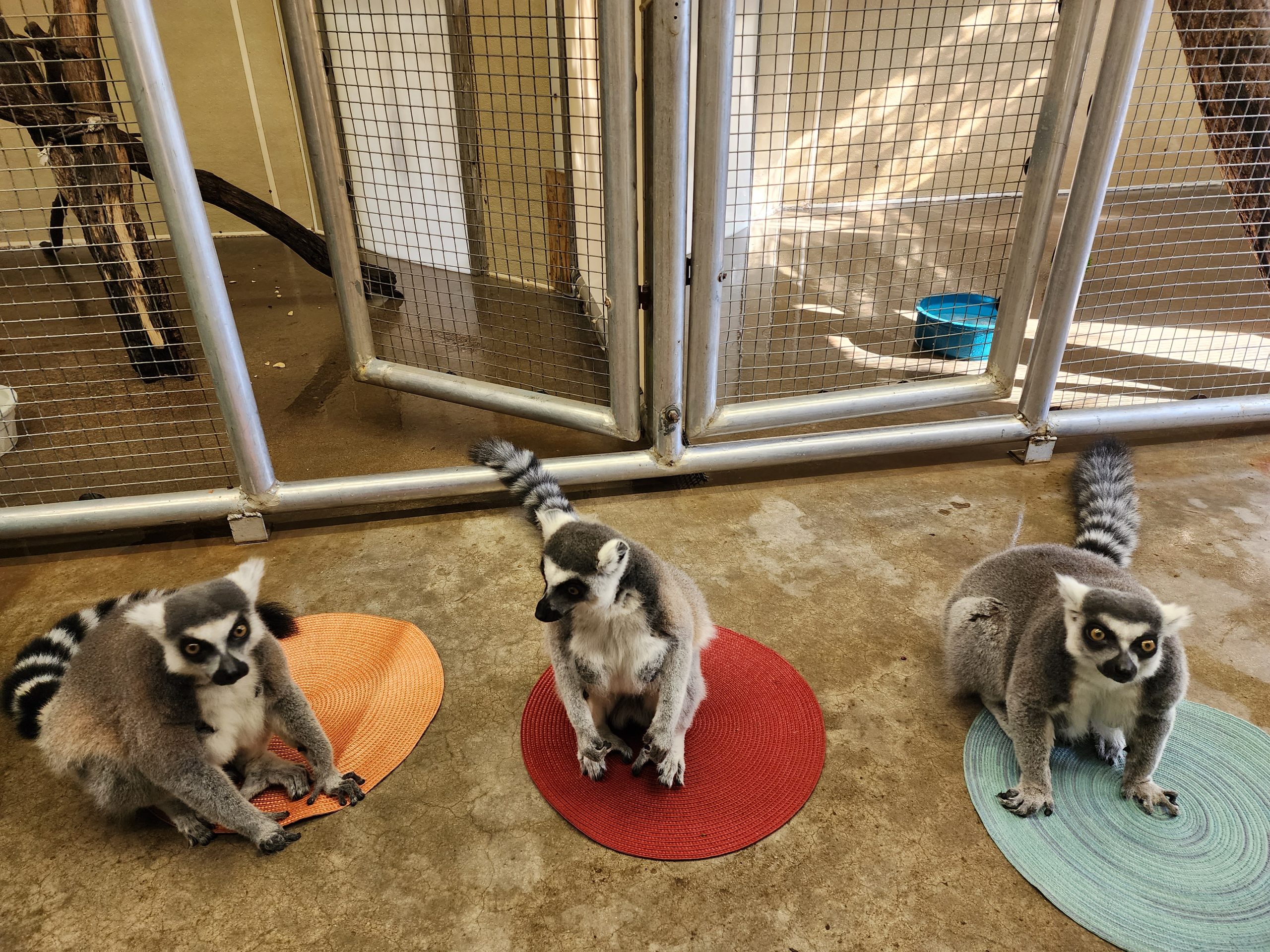
Ring-tailed lemurs participating in station training with Karen in 2023.
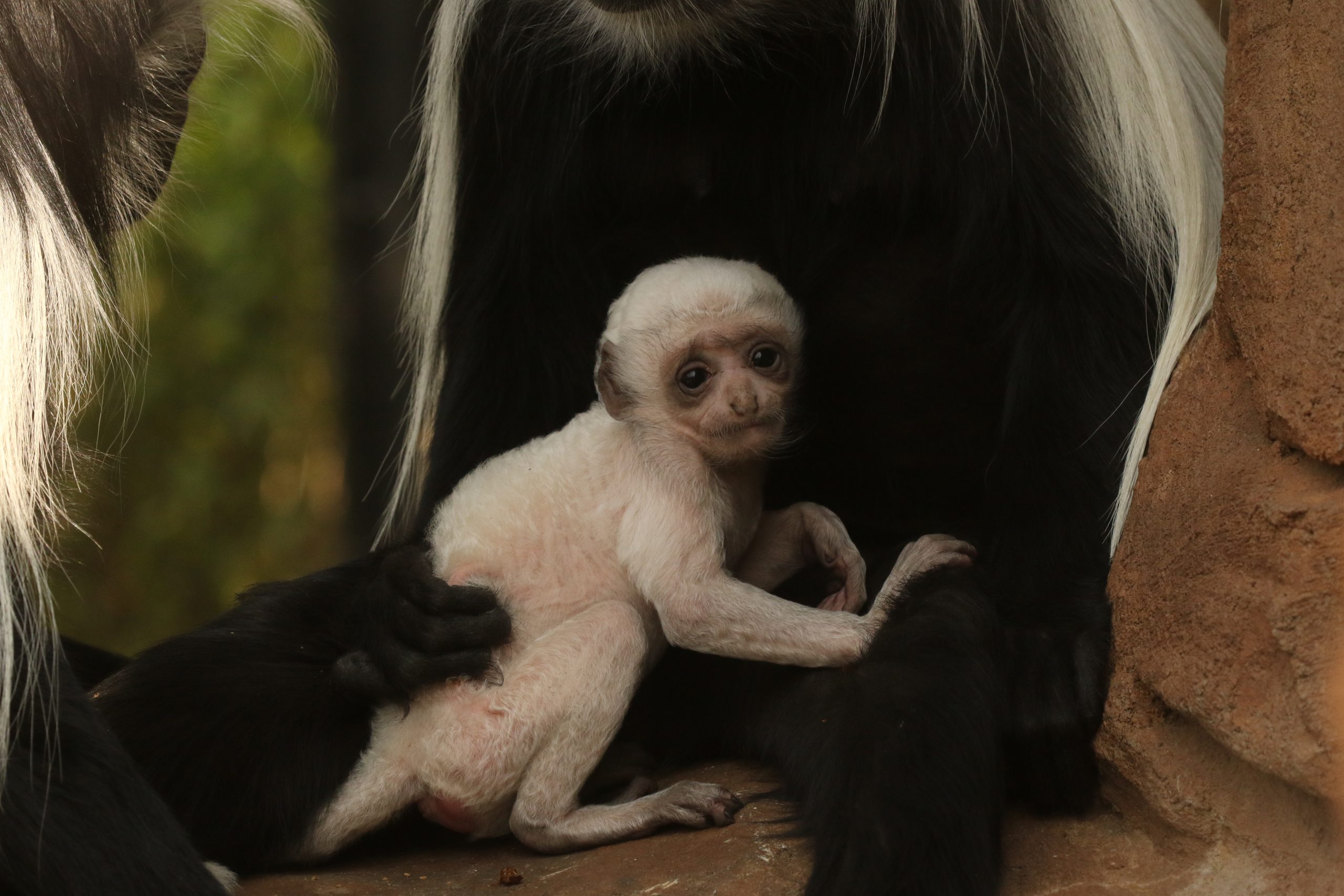
Ngumu, a baby colobus monkey, in 2023.
And then there’s the Little Rock Zoo itself.
“We have our ups and downs, some of the people change, but at our core we are a Zoo with a big heart,” Karen said. “We care about the animals, conservation, our guests and our community.”
For Karen, the people who make up the Zoo share something important: a genuine desire to make it the best it can be and to share their knowledge, passion and stories with the community.
After 30 years, it isn’t simply where Karen works.
“I truly LOVE the Little Rock Zoo,” she said. “It is home.”
A Job of the Heart
For Karen, 30 years of zookeeping can’t be summed up by one animal, one photograph, one memory or even one accomplishment.
It’s thousands of early mornings, holidays spent at the Zoo, habitats cleaned, diets prepared, behaviors observed, problems solved, lessons learned and relationships built one day at a time.
It’s also three decades of seeing animals as individuals—learning their personalities, earning their trust, caring for them through different stages of life and—through her photography—capturing moments that have allowed the rest of us to know them a little better, too.
Karen hopes her story helps guests understand the dedication behind the profession.
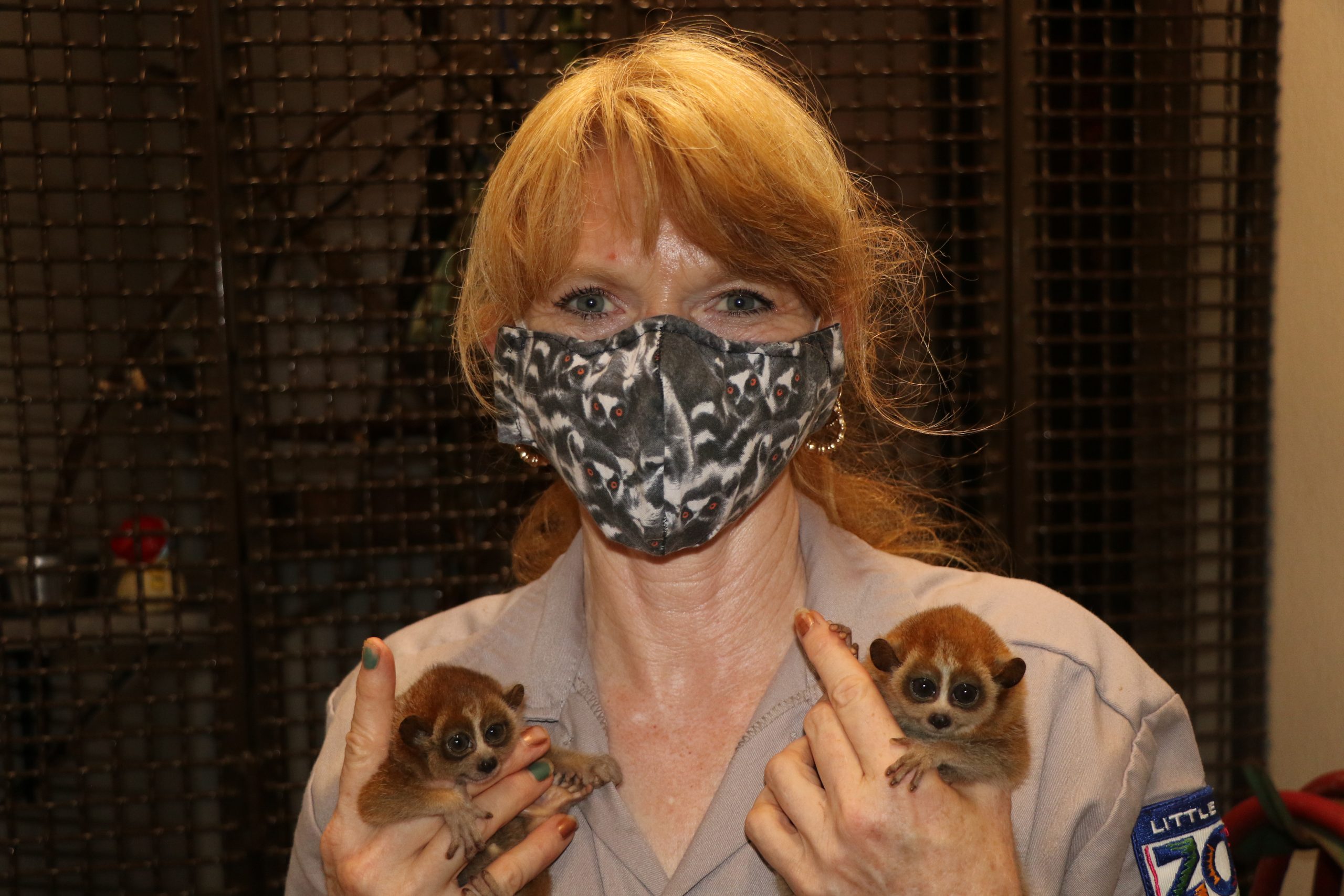
Karen holding twin baby pygmy slow lorises. The Little Rock Zoo is one of only a few zoological institutions to have successfully bred this endangered species.
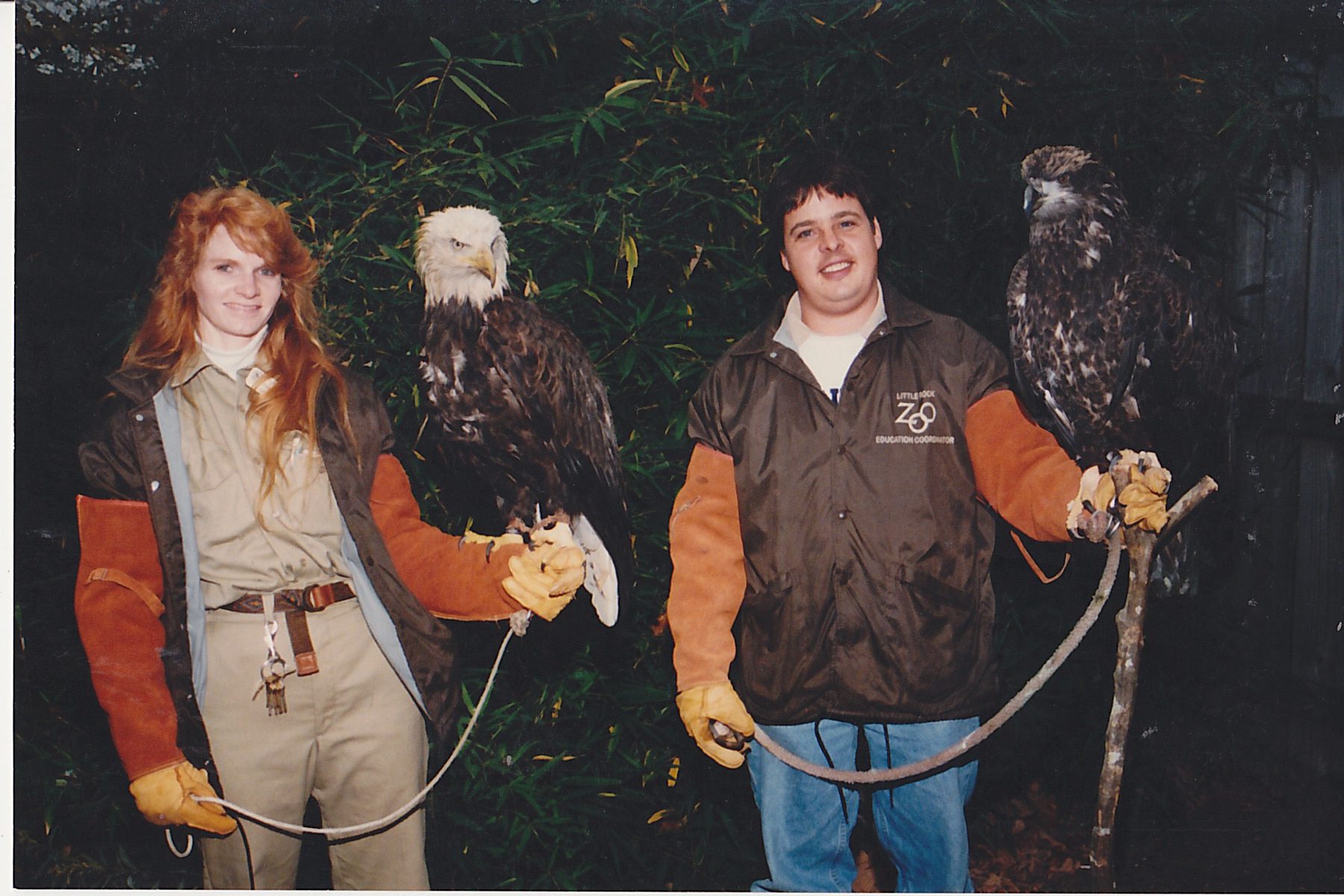
Karen holding bald eagle Leucus alongside Mark holding bald eagle Lynn in 1997. Lynn still lives at the Little Rock Zoo home today.
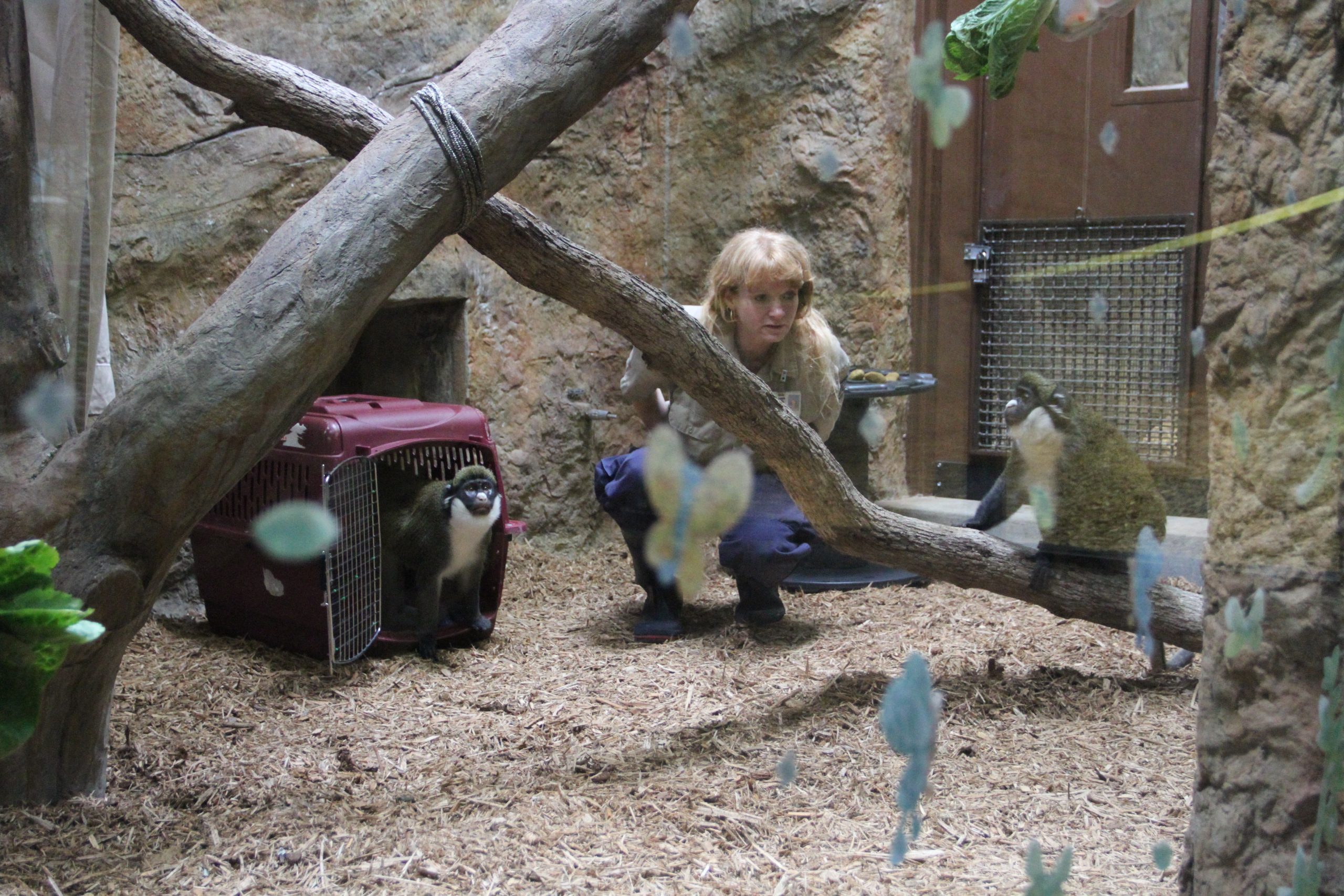
Karen working with guenon monkeys during introductions.
“Zookeepers are a group of hardworking, dedicated people with tremendous passion for what we do,” she said. “We give up family time. We work holidays. In general, we do whatever it takes to make the lives of the animals under our care the best our resources allow.”
“It is a job of the heart and a lifestyle. It doesn’t just stop when you clock out for the day.”
For 30 years, Karen has brought that heart to the Little Rock Zoo—as a keeper, colleague, photographer, storyteller and familiar face to generations of animals and guests.
We’re incredibly grateful that she has chosen to call the Little Rock Zoo home—and we’re proud to celebrate this remarkable milestone alongside her.